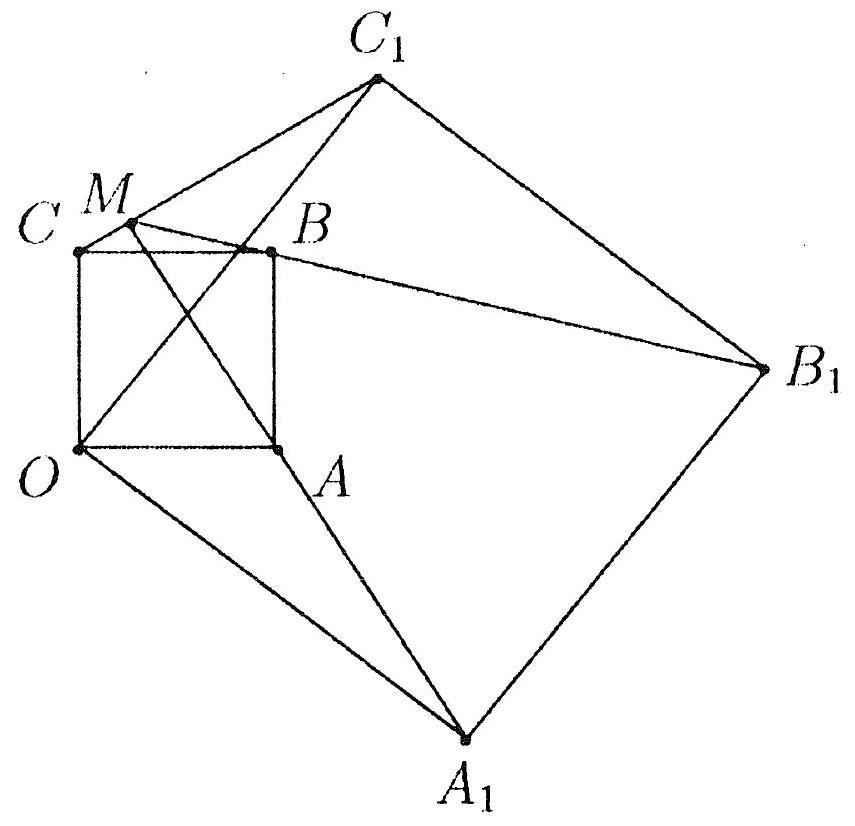
The squares OABC and OA1B1C1 are situated in the same plane and are directly oriented. Prove that the lines AA1, BB1, and CC1 are concurrent.
Solution
Let AA1∩CC1={M}. We have △AOA1≡△COC1 (S.A.S.), then AA1O≡MA1O≡CC1O. It follows that A1C1MO is cyclic, hence A1MC≡A1OC1=90∘, that is A1M⊥CC1.
The quadrilateral A1B1C1M is cyclic, then A1MB1≡A1C1B1=45∘.
The quadrilateral AOCM is cyclic, hence we have OMC≡OAC=45∘ and AMO≡ACO=45∘.
The quadrilateral OBMC is cyclic, since OMC≡OBC=45∘. It follows OMB=90∘.
We have A1MB=OMB−AMO=90∘−45∘=45∘,
hence A1MB1=AMB=45∘, that is points M,B,B1 are collinear. It follows that the lines AA1, BB1, CC1 are concurrent.
Solution 2:
We use complex coordinates. Assume that the origin of the complex plane is at O and we have A(1), B(1+i), C(i). If A1(a1), then C1(a1i) and B1(a1(1+i)). As in the previous solution, consider AA1∩CC1={M}, and M(m). The points A1,A,M are collinear if and only if 1−a1m−a1∈R∗ That is equivalent to 1−a1m−a1=1−aˉ1mˉ−aˉ1.(1) The points C1,C,M are collinear if and only if i−a1im−a1i∈R∗ hence i−a1im−a1i=−i+aˉ1imˉ+aˉ1i(2) From (1) and (2) we get m=21[−1−aˉ1(1+i)aˉ1(1−a1)+(1+i)a1]=21+i⋅1−aˉ1a1−aˉ1. We have only to show that the points B1,B,M are collinear. That is 1+i−a1(1+i)m−a1(1+i)∈R∗ Indeed, 1+i−a1(1+i)m−a1(1+i)=1−a121⋅1−aˉ1a1−aˉ1−a1=−2(1−a1)(1−aˉ1)a1+aˉ1−a1aˉ1∈R∗
Want a route through all this instead of an archive? The track
puts 2,604 problems in a working order, from Junior Challenge level to the IMO shortlist.
Source: MathNet,
licensed CC-BY-4.0.
Statement reproduced verbatim; metadata (topic, difficulty) added by this project.