Olympiad Maths Prep

Library / /4 of 21

Geometry Difficulty 4.9 AIME Prove it Ukraine

For any real numbers x,yx, y prove the inequality
(x+4)2+(y+2)2+(x5)2+(y+4)2(x2)2+(y6)2+(x5)2+(y6)2+20. \sqrt{(x + 4)^2 + (y + 2)^2} + \sqrt{(x - 5)^2 + (y + 4)^2} \le \sqrt{(x - 2)^2 + (y - 6)^2} + \sqrt{(x - 5)^2 + (y - 6)^2} + 20.

Solution

On a coordinate plane consider points A(4,2)A(-4, -2), B(2,6)B(2, 6), C(5,6)C(5, 6) and D(5,4)D(5, -4) (fig. 2). For any point M(x,y)M(x, y) of the plane the inequality is rewritten as: MA+MDMBMC20MA + MD - MB - MC \le 20. Let's find the largest possible value of the expression
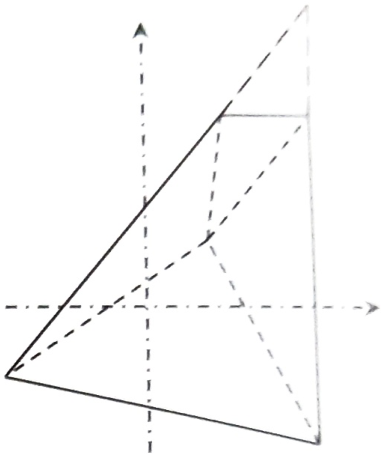
Figure 1
Fig. 2
S(M)=MA+MDMBMC. S(M) = MA + MD - MB - MC.
For any point MM of the plane from the triangle inequality we get:
S(M)=(MAMB)+(MDMC)AB+CD. S(M) = (MA - MB) + (MD - MC) \le AB + CD.
In addition, for the point X=ABCDX = AB \cap CD we get
S(X)=(XAXB)+(XDXC)=AB+CD=10+10=20. S(X) = (XA - XB) + (XD - XC) = AB + CD = 10 + 10 = 20.
So, the largest value is achieved for point XX, and for all others the inequality is strict.

Looking for a route rather than an archive? The track puts 2,000 problems in a working order, from AMC 10 level to the IMO shortlist.

Source: MathNet, licensed CC-BY-4.0. Statement and solution reproduced as published; topic and difficulty added by this site.