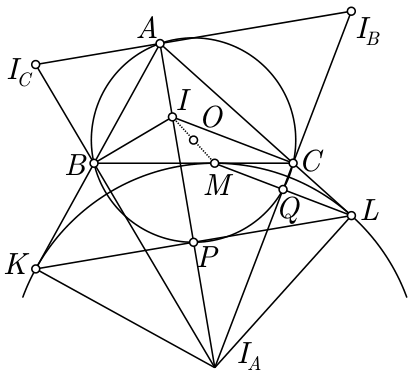
Leaving the trivial case AB=AC aside, we show that I, M, O all lie on the Euler line of the triangle formed by the three excenters IA, IB, IC. Recall that the Euler line of a triangle is the line through the orthocenter, the center of the nine-point circle and the circumcenter of that triangle. Since I is the orthocenter of the triangle IAIBIC, and O is the center of its nine-point circle, the line IO is indeed the Euler line of this triangle.
We now show that, if the midpoint of the segment KL lies on the circle ABC, then M is the circumcenter of the triangle IAIBIC. The conclusion then follows by the preceding.
To prove that M is the circumcenter of the triangle IAIBIC, we show that it lies on the perpendicular bisectrix of the segment IAIB; similarly, it lies on the perpendicular bisectrix of the segment IAIC, so it is indeed the circumcenter of the triangle IAIBIC.
Let P be the midpoint of the segment KL. Since AK=AL, the point P lies on the bisectrix AI of the angle BAC, so it is the midpoint of the circular arc BPC, and therefore lies on the perpendicular bisectrix of the segment BC; and since B and C both lie on the circle on diameter IIA (the angles IBIA and ICIA are both right), it follows that P is the midpoint of the segment IIA.
Clearly, the line IACIB is the perpendicular bisectrix of the segment LM, so it crosses the latter at its midpoint Q. Since PQ is a midline in the triangle KLM, it is parallel to KM, and since KM and BIIB are both perpendicular to IABIC, it follows that PQ and BIIB are parallel. Recall that P is the midpoint of the segment IIA, to infer that PQ is a midline in the triangle IIAIB, so Q is the midpoint of the segment IAIB. Consequently, M lies on the perpendicular bisectrix of the segment IAIB, as desired. This ends the proof.