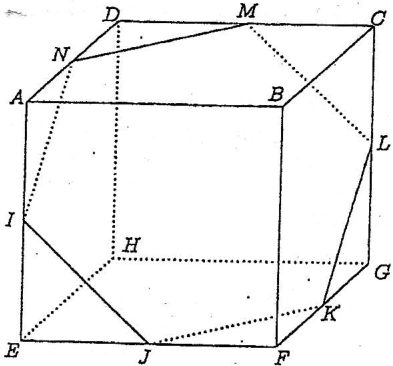
Suppose a cube ABCD-EFGH having a side length of 2012 and a plane are placed in space, and the intersection of the plane and the cube forms a hexagon IJKLMN, where the points I, J, K, L, M, N lie on the sides AE, EF, FG, GC, CD, DA, respectively, as shown in figure 3 below. If AI−GL=8, CM−EJ=6, FK−DN=4, determine the value obtained by subtracting the area of the hexagon IJKLMN from the sum of the areas of the triangles IKM and JLN. Here we denote for a line segment XY its length also by XY.
Solution
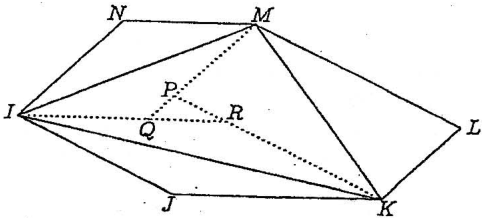
Take three points P, Q, R inside of the cube in such a way that the quadrilaterals KLMP, MNIQ and IJKR are parallelograms. Since IJ and ML are parallel, so are PK and RK, and we see that the points P, R, K lie on a same straight line. Therefore, we conclude that the hexagon IJKLMN is partitioned into 3 parallelograms and a triangle PQR as indicated in the figure below.
We then have ΔIKM=ΔIKR+ΔKMP+ΔMIQ+ΔPQR=21(□IJKR+□KLMP+□MNIQ)+ΔPQR=21(a−ΔPQR)+ΔPQR=21(a+ΔPQR).
Here we are denoting ΔXYZ and □XYZW for the areas of the triangle XYZ and of the quadrilateral XYZW, respectively. We note also that since P and R lie on the same side from K on the line PK, PR=∣PK−RK∣=∣ML−IJ∣ holds. Similarly, we have PQ=∣NI−LK∣ and QR=∣JK−MN∣.
Next, take three points P′, Q′, R′ inside of the cube so that the quadrilaterals NIJP′, JKLQ′, LMNR′ are parallelograms. Then, in the same way as above, we obtain that ΔJLN=21(a+ΔP′Q′R′). Furthermore, we get P′R′=∣ML−IJ∣=PR, P′Q′=∣NI−LK∣=PQ and Q′R′=∣JK−MN∣=QR. Hence, the triangles PQR and P′Q′R′ are congruent, and in particular, we have ΔPQR=ΔP′Q′R′. Thus we obtain the fact that the answer we seek is ΔIKM+ΔJLN−a=ΔPQR, and thus it is enough to find the area of the triangle PQR.
Let us now observe that the right triangles EJI and CML are similar since the corresponding sides are parallel. Therefore, we have EJ:EI:IJ=(CM−EJ):(CL−EI):(LM−IJ)=6:((2012−GL)−(2012−AI)):(ML−IJ)=6:8:(ML−IJ). Since the triangle for which the ratios of the lengths of the three sides are 6:8:∣ML−IJ∣ is a right triangle whose hypotenuse is the side with length ∣ML−IJ∣, we get ∣ML−IJ∣=62+82=10. Thus, we get PR=10. Similarly, we obtain PQ=∣NI−LK∣=42+82=45 and QR=∣JK−MN∣=42+62=213.
Let S be the foot of the perpendicular line drawn from Q to PR and let x=RS (assume that if S lies on the opposite side from P with respect to R, then x is negative). Then, from the Pythagorean theorem, we get (213)2−x2=QS2=(45)2−(10−x)2. Solving for x we obtain x=518, and then we get QS=5461. Finally, we obtain ΔPQR=21⋅10⋅5461=461, which is the desired answer for the problem.
Want a route through all this instead of an archive? The track
puts 2,604 problems in a working order, from Junior Challenge level to the IMO shortlist.
Source: MathNet,
licensed CC-BY-4.0.
Statement reproduced verbatim; metadata (topic, difficulty) added by this project.