There are () players in a table tennis tournament, in which any two players have a match. Player is called not out-performed by player , if at least one of player 's losers is not a 's loser.
Determine, with proof, all possible values of , such that the following case could happen: after finishing all the matches, every player is not out-performed by any other player.
China Western Mathematical Olympiad
Solution
The answer is or .
(1) For , suppose , and are three players, and the result of three matches are as follows: wins , wins , and wins . These results obviously satisfy the condition.
(2) If , suppose that the condition holds, i.e., in view of the results of all matches, every player is not out-performed by any other player. It is obvious that none of these four players wins in his three games, otherwise, the other three players will be not out-performed by this player. Similarly, none of these three players loses in his three games. It follows that each player wins one or two matches.
For the player , assume that wins and , but loses to , then both and win ; otherwise, they would not out-performed . For the loser in the match vs. , he only wins , and so the loser is impossible to be not out-performed by the winner. Consequently, for , the given condition could not happen.
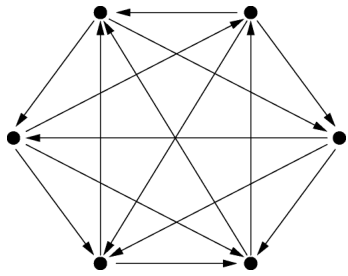
(3) For , one can construct the tournament results by means of the following directed graph, in which each black dot represents a player, and represents a match with the result that player wins player .
(4) If there exist tournament results such that each of players () is not out-performed by any other player, we will prove that the same holds for players as follows: Suppose that and are the additional players to the original players. Construct the game results of and as follows:
for all , and the game results among 's are still the original ones. Now we want to check that these players satisfy the given condition. For any player , then it suffices to consider the players , and it reduces to the case .
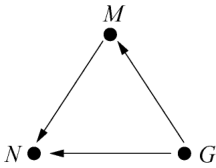
One can check that each of these three players is not out-performed by any one of the other two players. Hence, the tournament result of these players satisfies the required condition.
In particular, it follows from (1) and the induction step of (4) that the required condition holds for any odd with . Moreover, it follows from (3) and the induction step of (4) that the required condition holds for any even with , and it completes the proof.
Want a route through all this instead of an archive? The track
puts 2,604 problems in a working order, from Junior Challenge level to the IMO shortlist.