Given two hyperbolae and with the equations and , respectively. Let be an arbitrary point on . Let and be the tangency points of the lines and with the hyperbola .
Prove that the line is tangent line of .
Belarus — Final Round
Solution
Without loss of generality we may assume that the point lies on the upper-right half-hyperbola , . and be the points of tangency with , mentioned in the problem condition (see the Fig.).
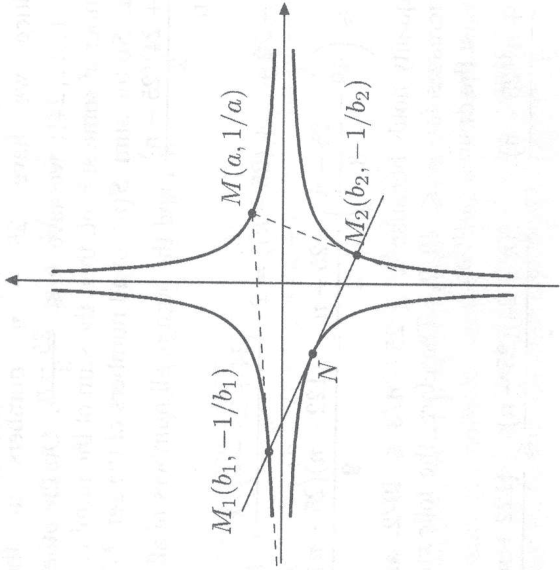
Since the derivative of the function is equal to , the equation of the line tangent to at has the form
Since belongs to this tangent, we have . Therefore, the abscissae and of and satisfy the equation
The equation of the straight line passing through can be written as , and if this line passes through , then
, so since . Therefore, the equation of the line has the form
Since and are the roots of (1), by Vieta's theorem, we have , . Then the equation of the line has the form
Note that , for , i.e., the point lying on the hyperbola belongs to the line . It remains to note that the slope of the line tangent to at is equal to , i.e., coincides with the slope of the line . Therefore, the line touches the hyperbola (at the point ).
Want a route through all this instead of an archive? The track
puts 2,604 problems in a working order, from Junior Challenge level to the IMO shortlist.