On an infinite sheet of grid paper 999 grid squares are colored black. Call special a rectangle with sides on grid lines if it has two black opposite corner cells (rectangles with side 1 are included). Let be the maximum number of black cells in a special rectangle for a given configuration. Find the minimum of over all configurations.
Mathematical Olympiad Rioplatense
Solution
The minimum of is 201.
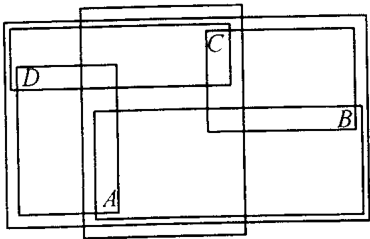
In an arbitrary configuration take the minimal rectangle that contains all black cells. Choose a black cell on every side (there is at least one by minimality) and label these as in the first figure. Consider the special rectangles and . Here we write for the grid rectangle with opposite corner cells and (they determine the rectangle uniquely). Note that if the part of to the left of rectangle is ignored, the remainder is covered by and . Likewise if the part of to the right of is ignored, the remainder is covered by and . Hence the entire is covered by the five rectangles, with certain overlaps. Each of cells and belongs to 3 of the 5 rectangles; each of and belongs to 2 of them. (There may be other black cells contained in more than one rectangle.) Hence if are the numbers of black cells in the 5 rectangles we obtain . This is because the sum counts each black cell except at least once, each of and at least twice, and each of and at least thrice. It follows that one of is at least . So there is always a special rectangle with at least 201 black cells. Therefore for every configuration.
We tacitly assumed that are distinct. This can be ensured indeed unless there are no black cells on some two adjacent sides of except their common corner cell. But then it is clear that can be covered by at most 3 special rectangles like the ones above, so . (We ignore the trivial case where has a side 1.)
Now we show an example where . In the second figure the 999 black squares are inside a big grid square, with . Four groups 1, 2, 3, 4 of 200 black cells each are placed in the corner squares as shown, in a diagonal-like manner.
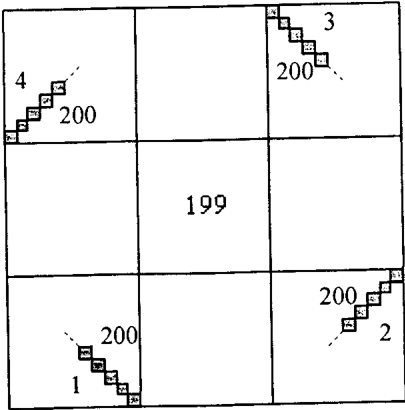
Let and be opposite black corner cells of a special rectangle which contains black cells. If and are in the same group it is clear that . If and are in adjacent groups among 1, 2, 3, 4 then intersects only these two groups. In addition observe that one of the two groups has exactly one cell in (this is or ). Thus .
Let and be in opposite corner groups, say 1 and 3. Then does not intersect groups 2 and 4. Moreover and are the only black cells of from groups 1 and 3. The remaining ones are all in the central part. Hence . Finally let one of and be in the central group, say . If is also there then . And if is in a corner group then is the only black cell of out of the central part. So which completes the solution.
Want a route through all this instead of an archive? The track
puts 2,604 problems in a working order, from Junior Challenge level to the IMO shortlist.