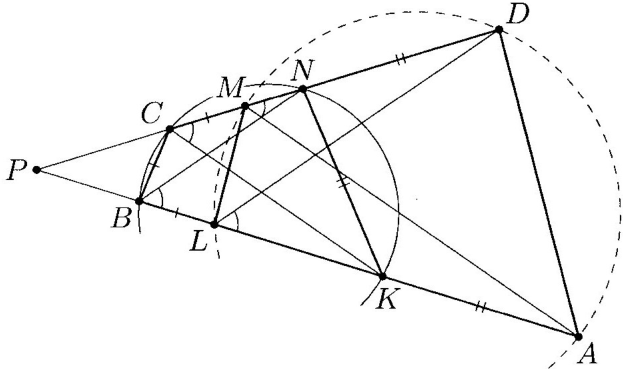
Points K and L are chosen on a side AB of a convex quadrilateral ABCD, with K lying between A and L. Similarly, points M and N are chosen on a side CD, with M lying between C and N. It appears that AK=KN=DN and BL=BC=CM. Given that BCNK is a cyclic quadrilateral, prove that ADML is also cyclic. (T. Zimanov, P. Kozhevnikov)
На стороне AB выпуклого четырехугольника ABCD взяты точки K и L (точка K лежит между A и L), а на стороне CD взяты точки M и N (точка M между C и N). Известно, что AK=KN=DN и BL=BC=CM. Докажите, что если BCNK — вписанный четырехугольник, то и ADML тоже вписан.
Solution
In the case AB∥CD, we have BC=KN, so AK=BL=CM=DN. Therefore, the quadrilateral LMDA is obtained from BCNK by a parallel translation by the vector BL.
Now suppose AB and CD are not parallel; let P be the intersection point of the lines AB and CD. Since the quadrilateral BCNK is cyclic, triangles PBC and PNK are similar; hence BLPB=NKPN=NDPN. Therefore, BN∥LD (see figure). Similarly, CK∥MA. From this, we get ∠ALD=∠KBN and ∠KCN=∠AMD.
Since the quadrilateral BCNK is cyclic, ∠KBN=∠KCN. Therefore, ∠ALD=∠AMD, that is, ADML is also cyclic.
Remark. There are other solutions; for example, from the equalities ∠AKN=∠NCB and ∠DNK=∠KBC, it follows that the quadrilaterals BCML and NKAD are similar, so ∠BLM=∠MDA.
Want a route through all this instead of an archive? The track
puts 2,604 problems in a working order, from Junior Challenge level to the IMO shortlist.
Source: MathNet,
licensed CC-BY-4.0.
Statement reproduced verbatim; metadata (topic, difficulty) added by this project.