Maths Olympiad Prep

Library / /57 of 86

Geometry Difficulty 6.5 National olympiad Prove it Estonia

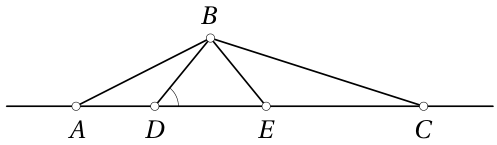
Points AA, DD, EE and CC lie on a line in this order. Point BB is chosen such that triangles ADBADB and BECBEC are similar (in this specific order of vertices), moreover EC=2ADEC = 2AD and ABC=120\angle ABC = 120^\circ. Find ACAD\frac{AC}{AD}.

Solutions — 2

Solution 1

Answer: 3+23 + \sqrt{2}.

Denote EDB=α\angle EDB = \alpha (Fig. 32). The similarity of ADBADB and BECBEC yields DAB=EBC\angle DAB = \angle EBC and BDA=CEB\angle BDA = \angle CEB; the second of which gives DEB=180CEB=180BDA=EDB=α\angle DEB = 180^\circ - \angle CEB = 180^\circ - \angle BDA = \angle EDB = \alpha. Therefore DB=BEDB = BE. Hence the similarity of ADBADB and BECBEC yields BEAD=ECDB=ECBE\frac{BE}{AD} = \frac{EC}{DB} = \frac{EC}{BE}; thus (BEAD)2=BEADECBE=ECAD=2\left(\frac{BE}{AD}\right)^2 = \frac{BE}{AD} \cdot \frac{EC}{BE} = \frac{EC}{AD} = 2, which gives BEAD=2\frac{BE}{AD} = \sqrt{2} or BE=2ADBE = \sqrt{2}AD.

The isosceles triangle BDEBDE gives DBE=1802α\angle DBE = 180^\circ - 2\alpha. On the other hand,
DBE=120ABDEBC=120ABDDAB=120(ABD+DAB)=120α. \begin{aligned} \angle DBE &= 120^\circ - \angle ABD - \angle EBC = 120^\circ - \angle ABD - \angle DAB \\ &= 120^\circ - (\angle ABD + \angle DAB) = 120^\circ - \alpha. \end{aligned}
The equation 1802α=120α180^\circ - 2\alpha = 120^\circ - \alpha yields α=60\alpha = 60^\circ. So the triangle BDEBDE is equilateral, which yields DE=BE=2ADDE = BE = \sqrt{2}AD.

Therefore ACAD=AD+DE+ECAD=AD+2AD+2ADAD=1+2+2=3+2\frac{AC}{AD} = \frac{AD+DE+EC}{AD} = \frac{AD+\sqrt{2}AD+2AD}{AD} = 1 + \sqrt{2} + 2 = 3 + \sqrt{2}.

Figure 1

Solution 2

The similarity of ADBADB and BECBEC yields DAB=EBC\angle DAB = \angle EBC and ABD=BCE\angle ABD = \angle BCE. So the triangles ADBADB and BECBEC are also similar to ABCABC. Therefore ADB=BEC=ABC=120\angle ADB = \angle BEC = \angle ABC = 120^\circ. But this yields BDE=DEB=180120=60\angle BDE = \angle DEB = 180^\circ - 120^\circ = 60^\circ, meaning that the triangle BDEBDE is equilateral.

The similarity of ADBADB and ABCABC yields ADAB=ABAC\frac{AD}{AB} = \frac{AB}{AC}. The similarity of BECBEC and ABCABC yields ECBC=BCAC\frac{EC}{BC} = \frac{BC}{AC}. Combining these with 2AD=EC2AD = EC, we see that

Figure 1

Fig. 32

BC2=ECAC=2ADAC=2AB2. BC^2 = EC \cdot AC = 2AD \cdot AC = 2AB^2.
So BC=2ABBC = \sqrt{2}AB, meaning that the scale factor between triangles ADBADB and BECBEC is 2\sqrt{2}. Thus DE=BD=2ADDE = BD = \sqrt{2}AD.

Therefore ACAD=AD+DE+ECAD=AD+2AD+2ADAD=1+2+2=3+2. \text{Therefore } \frac{AC}{AD} = \frac{AD+DE+EC}{AD} = \frac{AD+\sqrt{2}AD+2AD}{AD} = 1+\sqrt{2}+2 = 3+\sqrt{2}.

Want a route through all this instead of an archive? The track puts 2,000 problems in a working order, from AMC 10 level to the IMO shortlist.

Source: MathNet, licensed CC-BY-4.0. Statement and solution reproduced as published; topic and difficulty added by this site.