Let be the incentre of acute-angled triangle . Let the incircle meet , , and at , , and , respectively. Let line intersect the circumcircle of the triangle at and , such that lies between and . Prove that .
(Slovakia)
Let be the incentre of acute-angled triangle . Let the incircle meet , , and at , , and , respectively. Let line intersect the circumcircle of the triangle at and , such that lies between and . Prove that .
(Slovakia)
Let and be the midpoints of the of the circumcircle, containing and opposite vertex , respectively. By , the right-angled kites and are similar. Consider the spiral similarity (dilation in case of ) that moves to . The directed angle in which changes directions is , same as and ; so lines and are mapped to lines and , respectively. Line is mapped to ; we can see that the intersection points and are mapped to points and , respectively. Denote these points by and , respectively.
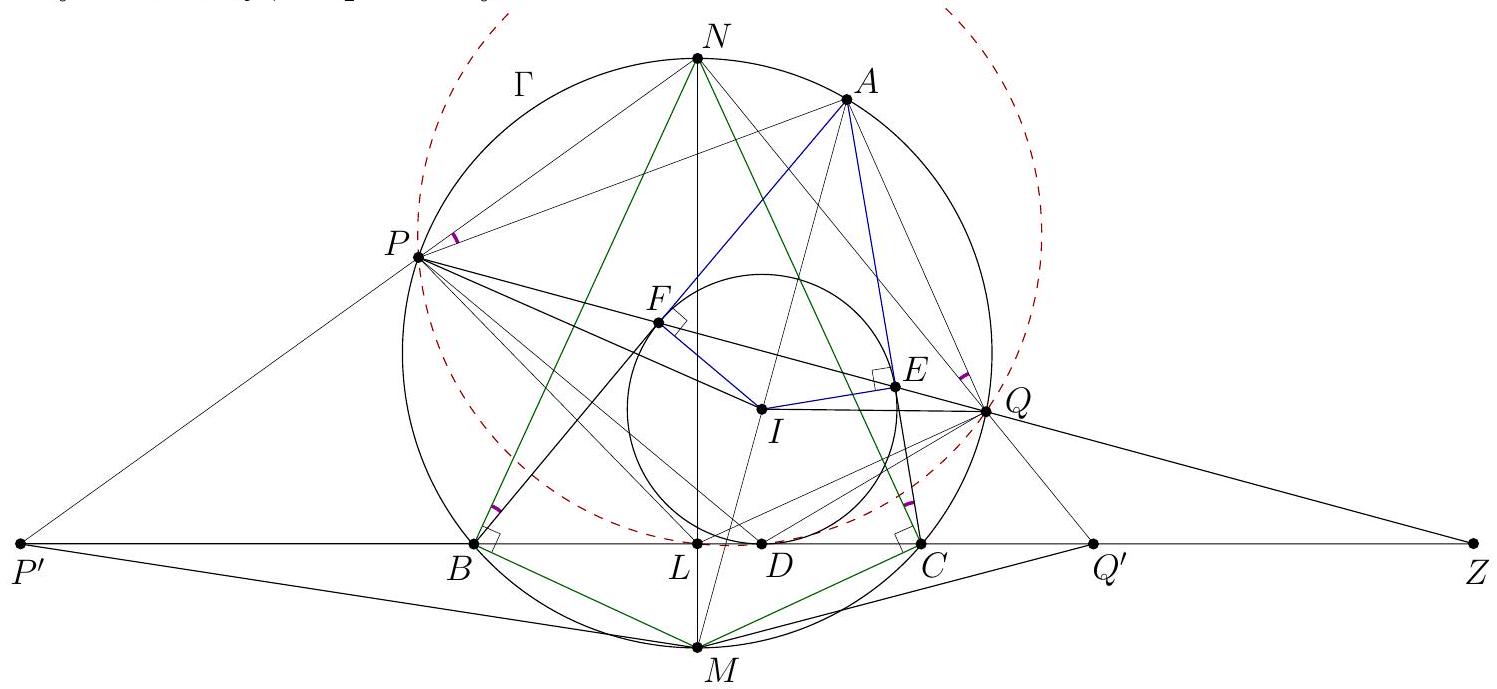
Let be the midpoint of . We claim that points are concyclic (if then line is tangent to circle ). Let and meet at . By applying Menelaus' theorem to triangle and line , we have
so the pairs and are harmonic. It is well-known that this implies . (The inversion with pole that swaps and sends to infinity and to the midpoint of , because the cross-ratio is preserved.) Hence, by the power of with respect to the circumcircle; this proves our claim.
By , the quadrilaterals and are cyclic. Then the problem statement follows by
Define the point and the same spiral similarity as in the previous solution. (The point is not necessary.) It is well-known that the centre of the spiral similarity that maps to is the Miquel point of the lines and ; that is, the second intersection of circles and . Denote that point by .
By and the triangles and are similar, so we have
By the converse of the angle bisector theorem, that indicates that line bisects and hence passes through .
Let be the intersection point of lines and . Notice that sends points to , so . By , we have .
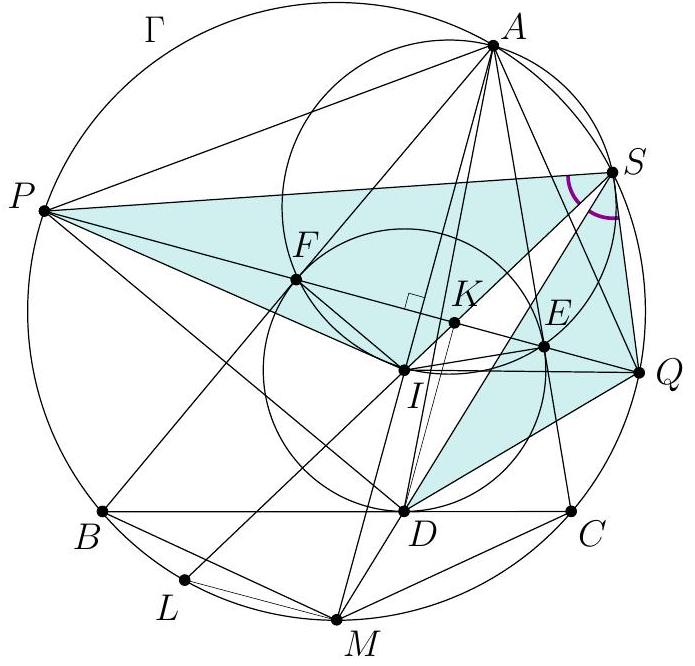
We claim that triangles and are similar, and so are triangles and . Let ray meet the circumcircle again at . Note that the segment is perpendicular to the angle bisector . Then by , we have . Hence, and therefore . By , the triangles and are similar. Finally,
shows that triangles and are similar. The second part of the claim can be proved analogously.
Now the problem statement can be proved by
Denote the circumcircle of triangle by , and let rays and meet again at and , respectively. We will show that and . Then the problem statement will follow as
Let be the midpoint of and let be the midpoint of ; the lines and being the internal and external bisectors of angle , respectively, are perpendicular. Let the tangents drawn to at and meet at ; let line meet and at and , respectively.
As in Solution 1, we observe that the pairs and are harmonic. Projecting these points from onto the circumcircle, we can see that and are also harmonic. Analogously, the pair is harmonic with . Consider the inversion about the circle with centre , passing through and . Points and are fixed points, so this inversion exchanges every point of by its harmonic pair with respect to . In particular, the inversion maps points to points , respectively.
Combine the inversion with projecting from to line ; the points are projected to , respectively.
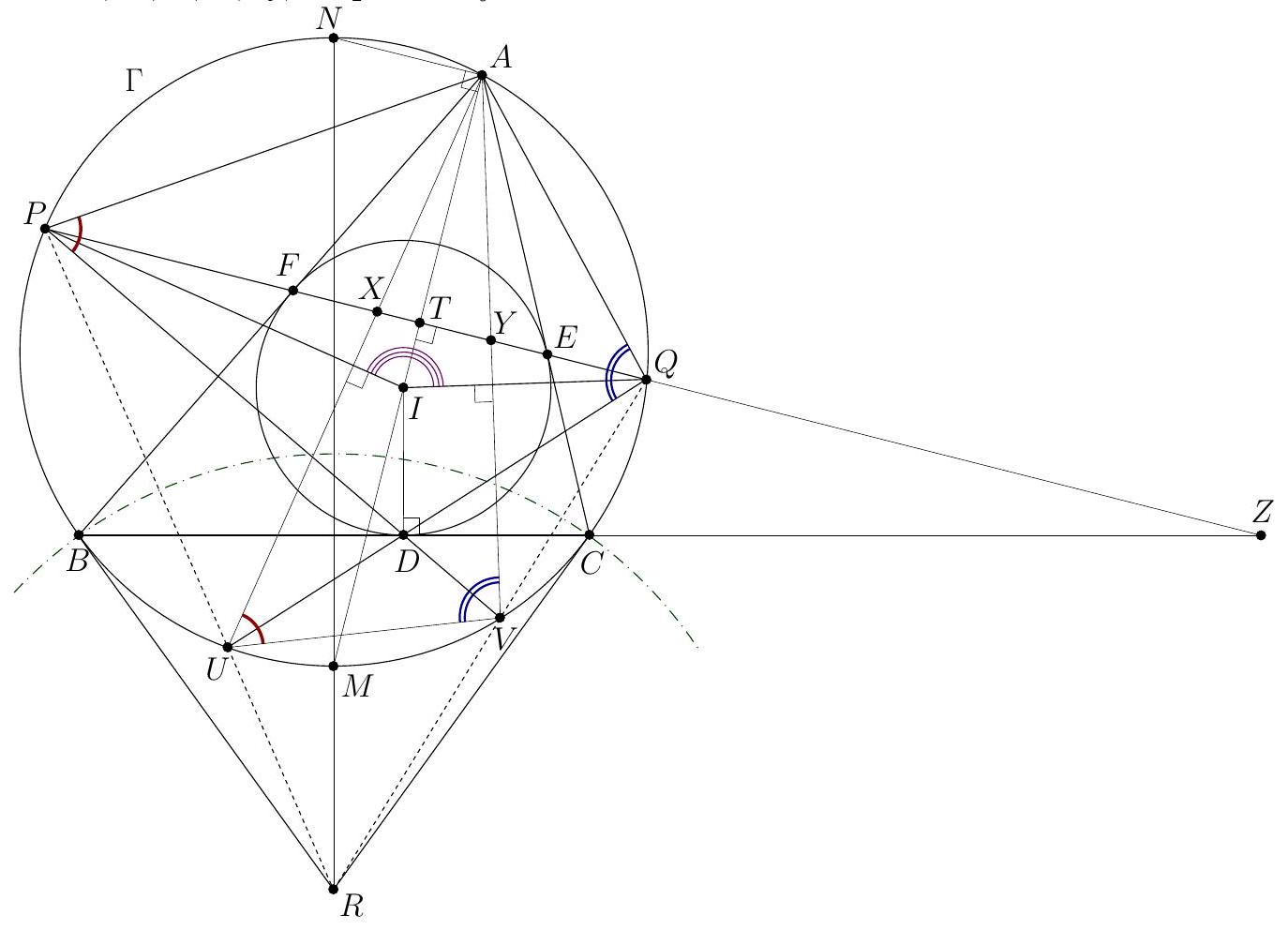
The combination of these two transformations is projective map from the lines , to , respectively. On the other hand, we have , and , so the corresponding lines in these two pencils are perpendicular. This proves and , and hence completes the solution.