Let be a cyclic hexagon, such that is the diameter of its circumcircle and the lines and are parallel. Let be the intersection of the segments and , let be the intersection of the segments and and let be the midpoint of the segment . Prove that .
Selection Examinations for the IMO
Solution
The segments and are parallel, so the quadrilateral is an isosceles trapezoid and . The inscribed angles over the chords and are equal, . Let . The segment is the diameter of a circle, so by Thales' theorem we have . From here we get , so . Similarly, , so .
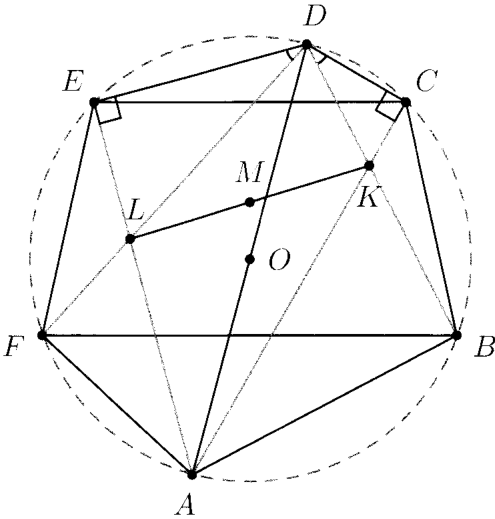
We have shown that and . The angles and over the two chords and of equal length are equal. If we somehow map the triangle so that gets mapped to , gets mapped to and the image of lies on the same side of the line as , then we will get a cyclic quadrilateral. The mapping with these properties is the reflection over the line of symmetry of the trapezoid . Denote this line by .
Let be the image of the point and let be the image of the point under the reflection over . Obviously, is the line of symmetry of the quadrilateral . This quadrilateral is an isosceles trapezoid (because and are parallel). Its diagonals and intersect on . We wish to show that the intersection of the diagonals is also the midpoint of each of them, which means we wish to show that is a rectangle. It suffices to show that the segment is parallel to .
Let be the image of and let be the image of under the reflection over . The point is the intersection of the lines and . Since is a cyclic quadrilateral, we have . The points and are concyclic, so . Hence, and the line is parallel to the line . The quadrilateral is a rectangle (the reflection makes it so that the segment is parallel to the segment , but and are the diameters, so and ). So, the segment is parallel to , which implies that . So, is a rectangle and its diagonals bisect each other. Their intersection lies on . Since lies on the distances of to the points and are the same.
Want a route through all this instead of an archive? The track
puts 2,604 problems in a working order, from Junior Challenge level to the IMO shortlist.