Let be a circle contained in the interior of another circle on the plane. Prove that there exists a point on the plane satisfying the following conditions: if is a line that does not contain , that intersects at two different points , and that intersects at two different points (so that lie in order on ), then .
China Team Selection Test for IMO, 2022
Solution
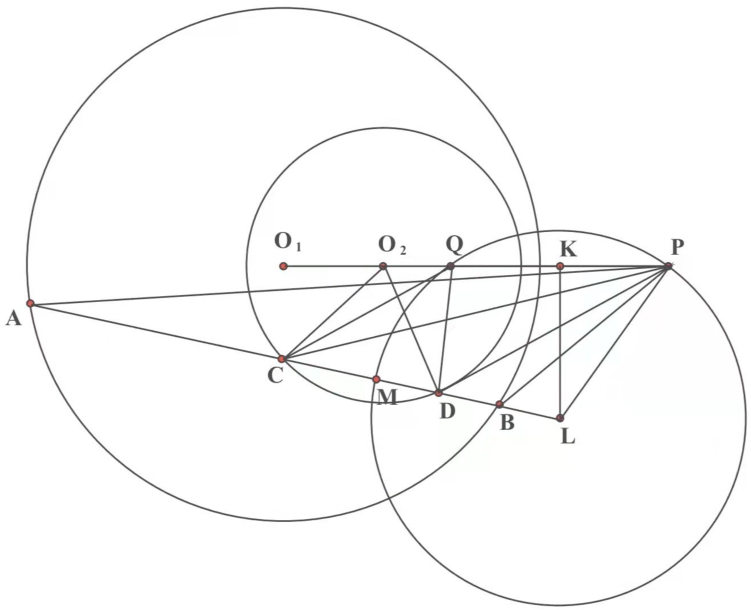
Proof. Denote the centers of the two circles by , and the radii by , respectively, where . We first show that there are two points on the ray such that and .
One can choose a point on the ray such that . Since , we have . We choose two points on the line such that so that . On the other hand,
which implies that .
For any given line as in the problem, if it is perpendicular to , we certainly have by symmetry. If not, from we know that . So . Similarly, we obtain , and therefore , which means that the bisectors of and meet at the same point, say . A similar argument shows that the bisectors of and intersect at the same point again, say .
Note that the points are all on an Apollonian circle with distance ratio to and . The center of the Apollonian circle must be on . Thus this center must be the intersection of with the perpendicular bisector of . Similarly, the points are on the Apollonius circle with distance ratio to and , whose center is the same point as above. Note that does not lie in the interior of , so the center of this circle, denoted by , must be outside so that coincides with . Therefore,
This completes the proof.
Want a route through all this instead of an archive? The track
puts 2,604 problems in a working order, from Junior Challenge level to the IMO shortlist.