Maths Olympiad Prep

Library / /22 of 38

Geometry Difficulty 6.8 National olympiad Prove it China

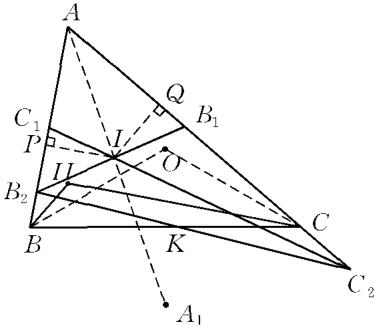
Suppose points II and HH are the incenter and orthocenter of an acute triangle ABCABC respectively, and points B1B_1 and C1C_1 are the midpoints of sides ACAC and ABAB respectively. It is known that ray B1IB_1I intersects side ABAB at B2B_2 (B2BB_2 \neq B), and ray C1IC_1I intersects the extension of ACAC at C2C_2: B2C2B_2C_2 and BCBC intersect at KK and A1A_1 is the circumcenter of BHC\triangle BHC. Prove that three points AA, II and A1A_1 are collinear if and only if the areas of BKB2\triangle BKB_2 and CKC2\triangle CKC_2 are equal. (posed by Shen Wenxuan)

Solution

Proof First, we will prove that three points AA, II and A1A_1 are collinear BAC=60\Leftrightarrow \angle BAC = 60^\circ.
As shown in the figure, assume that OO is the circumcenter of ABC\triangle ABC. We join BOBO and COCO, then
Figure 1
BHC=180BAC, \angle BHC = 180^\circ - \angle BAC,
BA1C=2(180BHC)=2BAC. \angle BA_1C = 2(180^\circ - \angle BHC) = 2\angle BAC.
Hence, BAC=60BAC+BA1C=180 \text{Hence, } \angle BAC = 60^\circ \Leftrightarrow \angle BAC + \angle BA_1C = 180^\circ
A1 is on the circumcircle O of ABC \Leftrightarrow A_1 \text{ is on the circumcircle } \odot O \text{ of } \triangle ABC
AI and AA1 coincide (because A1 is on the perpendicular bisector of BC.) \Leftrightarrow AI \text{ and } AA_1 \text{ coincide (because } A_1 \text{ is on the perpendicular bisector of } BC. )
Three points A,I and A1 are collinear. \Leftrightarrow \text{Three points } A, I \text{ and } A_1 \text{ are collinear.}

Secondly, we will prove SBKB2=SCKC2BAC=60S_{\triangle BKB_2} = S_{\triangle CKC_2} \Leftrightarrow \angle BAC = 60^\circ.

Construct IPABIP \perp AB at point PP, and IQACIQ \perp AC at QQ, then
SAB1B2=12IPAB2+12IQAB1. S_{\triangle AB_1 B_2} = \frac{1}{2} IP \cdot AB_2 + \frac{1}{2} IQ \cdot AB_1.
Note that SAB1B2=12AB1AB2sinAS_{\triangle AB_1 B_2} = \frac{1}{2} AB_1 \cdot AB_2 \cdot \sin A,
therefore IPAB2+IQAB1=AB1AB2sinAIP \cdot AB_2 + IQ \cdot AB_1 = AB_1 \cdot AB_2 \cdot \sin A.
Assume IP=rIP = r, where rr is the radius of the inscribed circle of ABC\triangle ABC. Then IQ=rIQ = r. Furthermore set BC=aBC = a, CA=bCA = b and AB=cAB = c, then r=2SABCa+b+cr = \frac{2S_{\triangle ABC}}{a+b+c}.
From AB1=b2AB_1 = \frac{b}{2} and 2AB1sinA=hc=2SABCc2AB_1 \cdot \sin A = h_c = \frac{2S_{\triangle ABC}}{c},
we have AB2[2SABCc22SABCa+b+c]=b2SABCa+b+cAB_2 \cdot \left[ \frac{2S_{\triangle ABC}}{c} - 2 \cdot \frac{2S_{\triangle ABC}}{a+b+c} \right] = b \cdot \frac{2S_{\triangle ABC}}{a+b+c},
so AB2=bca+b+cAB_2 = \frac{bc}{a+b+c}.
Similarly, AC2=bca+cbAC_2 = \frac{bc}{a+c-b}.
Hence,
SBKB2=SCKC2 S_{\triangle BKB_2} = S_{\triangle CKC_2}
SABC=SAB2C2 \Leftrightarrow S_{\triangle ABC} = S_{\triangle AB_2 C_2}
bc=bca+bcbca+cb \Leftrightarrow bc = \frac{bc}{a+b-c} \cdot \frac{bc}{a+c-b}
a2=b2+c2bc \Leftrightarrow a^2 = b^2 + c^2 - bc
BAC=60 (By the law of cosines). \Leftrightarrow \angle BAC = 60^\circ \text{ (By the law of cosines).}

Want a route through all this instead of an archive? The track puts 2,000 problems in a working order, from AMC 10 level to the IMO shortlist.

Source: MathNet, licensed CC-BY-4.0. Statement and solution reproduced as published; topic and difficulty added by this site.