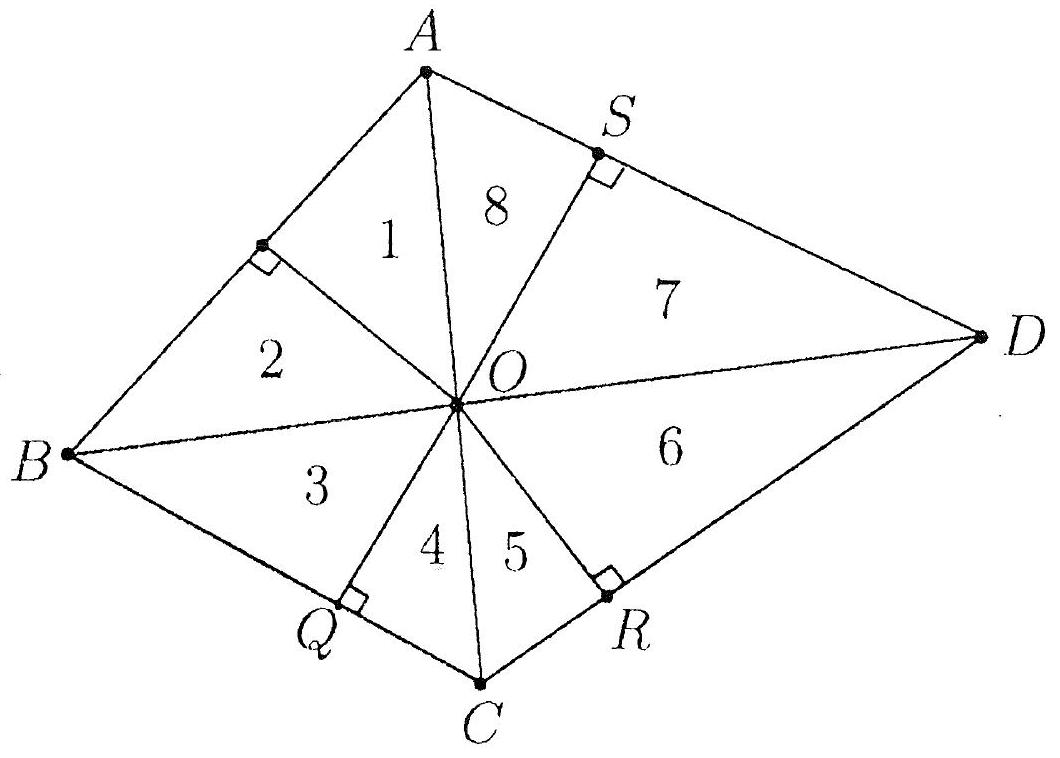
In quadrilateral ABCD, diagonals AC and BD intersect at O. Denote by P,Q,R,S the orthogonal projections of O onto AB,BC,CD,DA, respectively. Prove that PA⋅AB+RC⋅CD=21(AD2+BC2) if and only if QB⋅BC+SD⋅DA=21(AB2+CD2).
Solution
Denote by 1,2,…,8 the right angled triangles as in the above figure. Applying Pythagoras theorem successively in triangles 1,2,…,8, we get: PA2+PO2−OA2=0PB2−PO2−OB2=0QB2+QO2−OB2=0QC2+QO2−OC2=0RC2+RO2−OC2=0RD2+RO2−OD2=0SD2+SO2−OD2=0SA2+SO2−OA2=0 It follows PA2−PB2+QB2−QC2+RC2−RD2+SD2−SA2=0.(1) The last relation is equivalent to: PA2−(AB−PA)2+QB2−(BC−QB)2+RC2−(CD−RC)2+SD2−(DA−SD)2=0 hence 2(PA⋅AB+QB⋅BC+RC⋅CD+SD⋅DA)=AB2+BC2+CD2+DA2 and the conclusion follows.
Want a route through all this instead of an archive? The track
puts 2,604 problems in a working order, from Junior Challenge level to the IMO shortlist.
Source: MathNet,
licensed CC-BY-4.0.
Statement reproduced verbatim; metadata (topic, difficulty) added by this project.