Let be a triangle and its incenter. The line intersects the side at and the perpendicular bisector of at . Let be the incenter of triangle . Prove that triangle is isosceles.
Saudi Arabian Mathematical Competitions
Solution
It is well known that the bisector of the angle at vertex and the perpendicular bisector of side intersect on the circumcircle of triangle . We give here two solutions.
Solution 1. We have
On the other hand
.
Therefore, quadrilateral is cyclic.
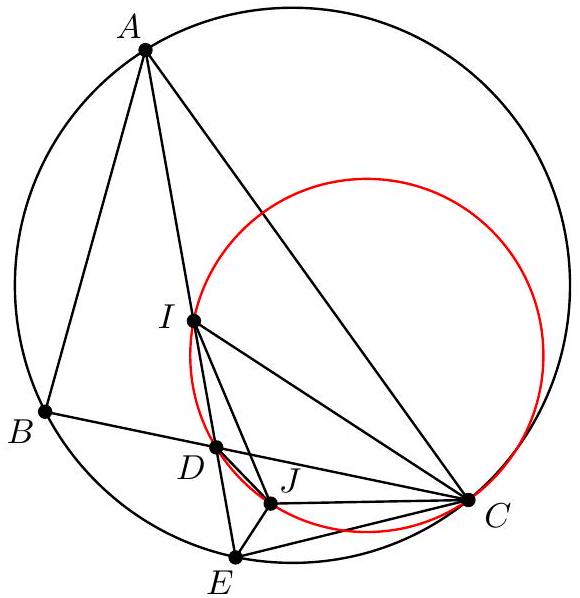
We deduce that
and triangle is isosceles.
Solution 2. It is well known that . This is because
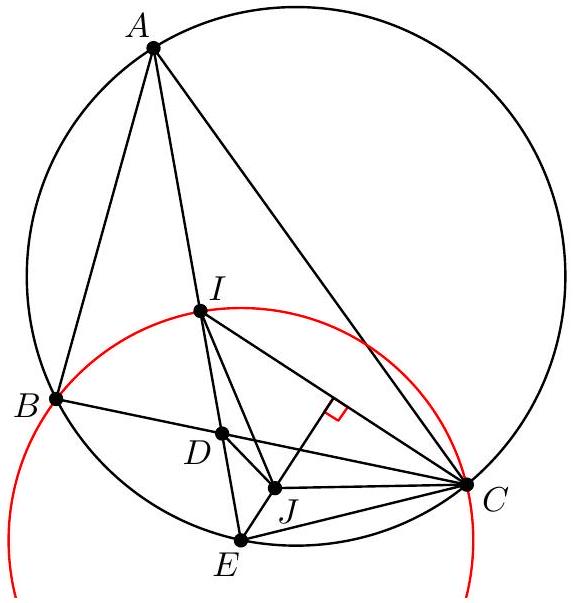
Therefore, the bisector of angle is the perpendicular bisector of segment . But is on this bisector. Hence, and triangle is isosceles.
Want a route through all this instead of an archive? The track
puts 2,604 problems in a working order, from Junior Challenge level to the IMO shortlist.