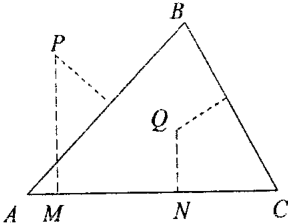
Let O be the circumcenter of ABC. Let our perpendicular bisectors meet sides AB and BC at points K and L respectively. Then KL is a midline of triangle ABC. Therefore, KL∥AC and 2KL=AC. Thus, MKLN is parallelogram, because KL∥MN and KL=MN. Due to the fact, that PM⊥AC and QN⊥AC, we have PN∥QN. Moreover, PM∥QN and KM∥LN, thus, ∠PMK=∠QNL (Fig.10).
∠AKP=∠AMP=90∘, thus P,K,M and A lie on the same circle with diameter PA. By analogy, we obtain that Q,N,C and L lie on the same circle with diameter CQ, points O,K,B and L belong to the circle with diameter BO. From these observations, it follows ∠PAK=∠PMK=∠QNL=∠QCL.
P and Q belong to perpendicular bisectors of the segments AB and BC respectively, thus APB and BQC are isosceles triangles. From this, we obtain ∠PBA=∠PAB=∠QCB=∠QBC. Hence, ∠PBQ=∠KBL=180∘−∠KOL=180∘−∠POQ, in other words, points P,B,Q,O are cyclic, which provides desired result.