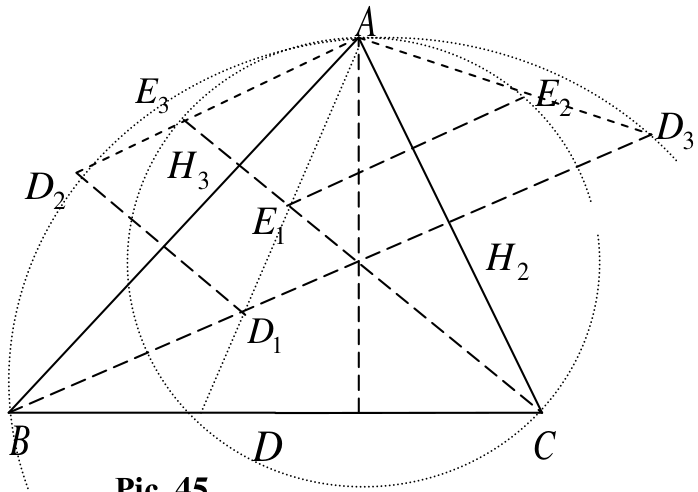
By E3,D3 we denote points that are symmetrical to E1,D1 with respect to AB and AC, respectively (Fig. 45). It follows from symmetry that AE1=AE2=AE3, and CA is a bisector of an angle that is created by the lines CE3 and CE2. Then we have
∠(CE3,E3A)=∠(E1E3,E3A)=∠(AE1,E1E3)=∠(AE1,E1C)=∠(CE2,E2A).
Thus points A, E2, E3 and C are cyclic.
In the same way points A, D2, D3 and B are cyclic. Then the circumcircle of the triangle △ABD2 coincides with the circumcircle of △AD3D2. In the same way, the circumcircle of △ACE2 coincides with the circumcircle of △AE3E2. Since AE3 and AD2 are symmetrical to the same line with respect to AB, then points A, E3, D2 are collinear. In the same way, A, E2, D3 are collinear. Moreover,
k=AE3AD2=AE1AD1=AE2AD3.
Thus △AE2E3∼△AD3D2, and their circumcircles are tangent to each other, because under homothety HAk one of the circles maps to the other circle and they have a common point A.
Pic. 45