Maths Olympiad Prep

Library / /82 of 106

Geometry Difficulty 8.7 Shortlist Prove it IMO

Let ABCABC be a triangle, and let 1\ell_{1} and 2\ell_{2} be two parallel lines. For i=1,2i=1,2, let i\ell_{i} meet the lines BCBC, CACA, and ABAB at XiX_{i}, YiY_{i}, and ZiZ_{i}, respectively. Suppose that the line through XiX_{i} perpendicular to BCBC, the line through YiY_{i} perpendicular to CACA, and finally the line through ZiZ_{i} perpendicular to ABAB, determine a non-degenerate triangle Δi\Delta_{i}.
Show that the circumcircles of Δ1\Delta_{1} and Δ2\Delta_{2} are tangent to each other.

Solutions — 2

Solution 1

Throughout the solutions, \Varangle(p,q)\Varangle(p, q) will denote the directed angle between lines pp and qq, taken modulo 180180^{\circ}.
Let the vertices of Δi\Delta_{i} be Di,Ei,FiD_{i}, E_{i}, F_{i}, such that lines EiFiE_{i}F_{i}, FiDiF_{i}D_{i} and DiEiD_{i}E_{i} are the perpendiculars through X,YX, Y and ZZ, respectively, and denote the circumcircle of Δi\Delta_{i} by ωi\omega_{i}.
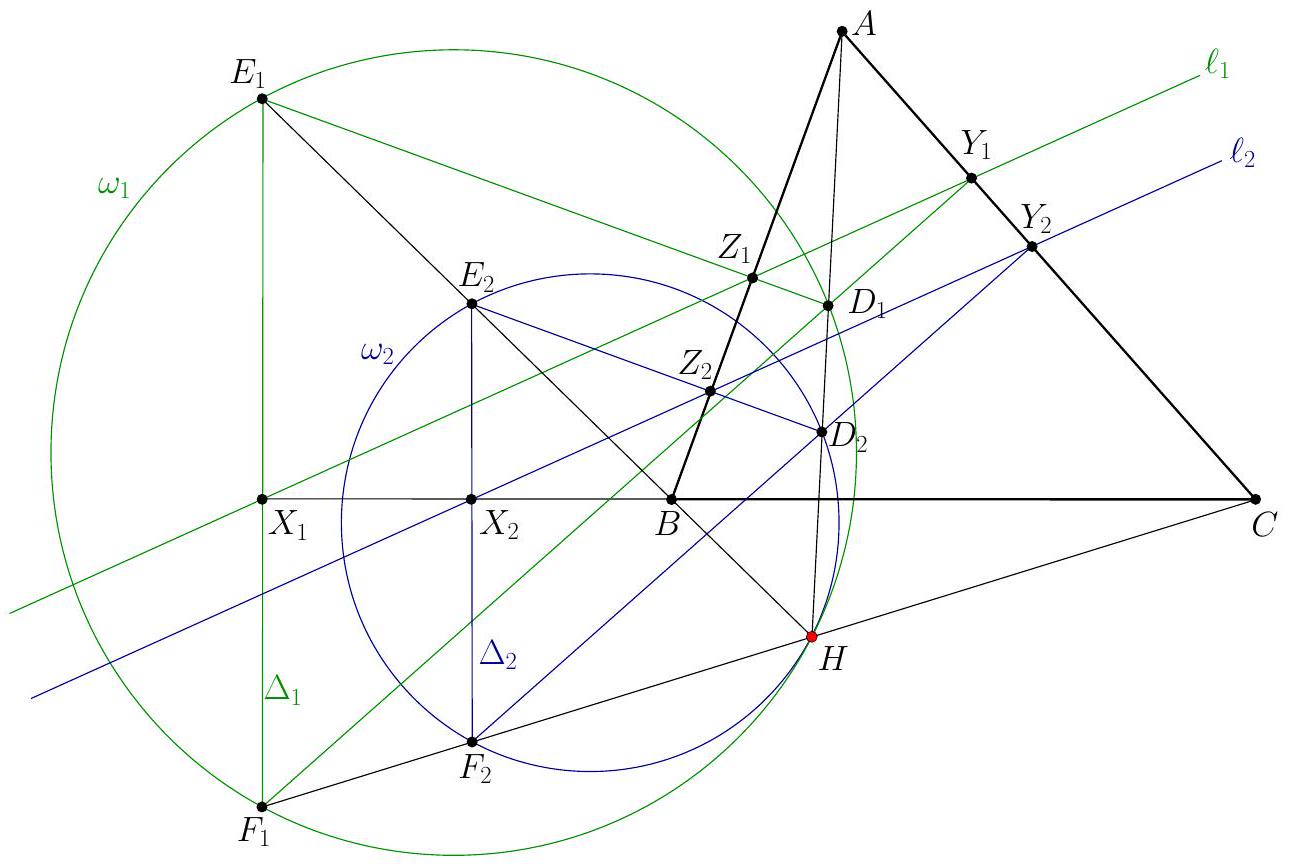
In triangles D1Y1Z1D_{1}Y_{1}Z_{1} and D2Y2Z2D_{2}Y_{2}Z_{2} we have Y1Z1Y2Z2Y_{1}Z_{1} \parallel Y_{2}Z_{2} because they are parts of 1\ell_{1} and 2\ell_{2}. Moreover, D1Y1D2Y2D_{1}Y_{1} \parallel D_{2}Y_{2} are perpendicular to ACAC and D1Z1D2Z2D_{1}Z_{1} \parallel D_{2}Z_{2} are perpendicular to ABAB, so the two triangles are homothetic and their homothetic centre is Y1Y2Z1Z2=AY_{1}Y_{2} \cap Z_{1}Z_{2} = A. Hence, line D1D2D_{1}D_{2} passes through AA. Analogously, line E1E2E_{1}E_{2} passes through BB and F1F2F_{1}F_{2} passes through CC.
Figure 1
The corresponding sides of Δ1\Delta_{1} and Δ2\Delta_{2} are parallel, because they are perpendicular to the respective sides of triangle ABCABC. Hence, Δ1\Delta_{1} and Δ2\Delta_{2} are either homothetic, or they can be translated to each other. Using that B,X2,Z2B, X_{2}, Z_{2} and E2E_{2} are concyclic, C,X2,Y2C, X_{2}, Y_{2} and F2F_{2} are concyclic, Z2E2ABZ_{2}E_{2} \perp AB and Y2,F2ACY_{2}, F_{2} \perp AC we can calculate
\Varangle(E1E2,F1F2)=\Varangle(E1E2,X1X2)+\Varangle(X1X2,F1F2)=\Varangle(BE2,BX2)+\Varangle(CX2,CF2)=\Varangle(Z2E2,Z2X2)+\Varangle(Y2X2,Y2F2)=\Varangle(Z2E2,2)+\Varangle(2,Y2F2)=\Varangle(Z2E2,Y2F2)=\Varangle(AB,AC)≢0, \begin{align*} \Varangle\left(E_{1}E_{2}, F_{1}F_{2}\right) &= \Varangle\left(E_{1}E_{2}, X_{1}X_{2}\right) + \Varangle\left(X_{1}X_{2}, F_{1}F_{2}\right) = \Varangle\left(BE_{2}, BX_{2}\right) + \Varangle\left(CX_{2}, CF_{2}\right) \\ &= \Varangle\left(Z_{2}E_{2}, Z_{2}X_{2}\right) + \Varangle\left(Y_{2}X_{2}, Y_{2}F_{2}\right) = \Varangle\left(Z_{2}E_{2}, \ell_{2}\right) + \Varangle\left(\ell_{2}, Y_{2}F_{2}\right) \\ &= \Varangle\left(Z_{2}E_{2}, Y_{2}F_{2}\right) = \Varangle(AB, AC) \not\equiv 0, \tag{1} \end{align*}
and conclude that lines E1E2E_{1}E_{2} and F1F2F_{1}F_{2} are not parallel. Hence, Δ1\Delta_{1} and Δ2\Delta_{2} are homothetic; the lines D1D2D_{1}D_{2}, E1E2E_{1}E_{2}, and F1F2F_{1}F_{2} are concurrent at the homothetic centre of the two triangles. Denote this homothetic centre by HH.
For i=1,2i=1,2, using (1), and that A,Yi,ZiA, Y_{i}, Z_{i} and DiD_{i} are concyclic,
\Varangle(HEi,HFi)=\Varangle(E1E2,F1F2)=\Varangle(AB,AC)=\Varangle(AZi,AYi)=\Varangle(DiZi,DiYi)=\Varangle(DiEi,DiFi), \begin{aligned} \Varangle\left(HE_{i}, HF_{i}\right) &= \Varangle\left(E_{1}E_{2}, F_{1}F_{2}\right) = \Varangle(AB, AC) \\ &= \Varangle\left(AZ_{i}, AY_{i}\right) = \Varangle\left(D_{i}Z_{i}, D_{i}Y_{i}\right) = \Varangle\left(D_{i}E_{i}, D_{i}F_{i}\right), \end{aligned}
so HH lies on circle ωi\omega_{i}.
The same homothety that maps Δ1\Delta_{1} to Δ2\Delta_{2}, sends ω1\omega_{1} to ω2\omega_{2} as well. Point HH, that is the centre of the homothety, is a common point of the two circles, That finishes proving that ω1\omega_{1} and ω2\omega_{2} are tangent to each other.

Solution 2

As in the first solution, let the vertices of Δi\Delta_{i} be Di,Ei,FiD_{i}, E_{i}, F_{i}, such that EiFiE_{i}F_{i}, FiDiF_{i}D_{i} and DiEiD_{i}E_{i} are the perpendiculars through Xi,YiX_{i}, Y_{i} and ZiZ_{i}, respectively. In the same way we conclude that (A,D1,D2),(B,E1,E2)\left(A, D_{1}, D_{2}\right), \left(B, E_{1}, E_{2}\right) and (C,F1,F2)\left(C, F_{1}, F_{2}\right) are collinear.
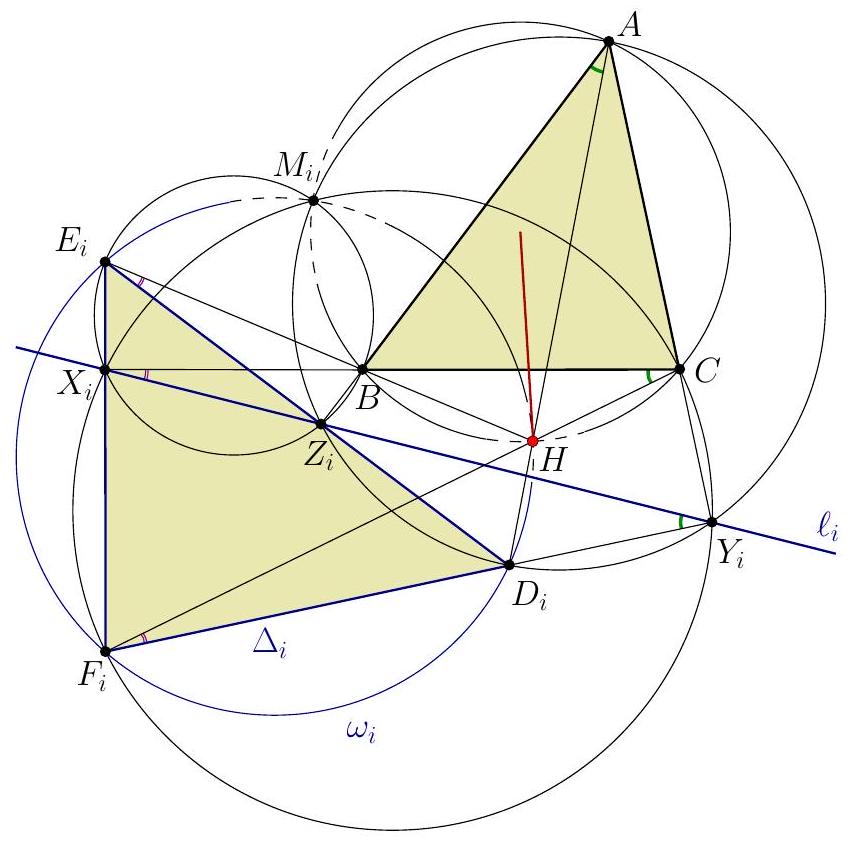
The corresponding sides of triangles ABCABC and DiEiFiD_{i}E_{i}F_{i} are perpendicular to each other. Hence, there is a spiral similarity with rotation ±90\pm 90^{\circ} that maps ABCABC to DiEiFiD_{i}E_{i}F_{i}; let MiM_{i} be the centre of that similarity. Hence, \Varangle(MiA,MiDi)=\Varangle(MiB,MiEi)=\Varangle(MiC,MiFi)=90\Varangle\left(M_{i}A, M_{i}D_{i}\right) = \Varangle\left(M_{i}B, M_{i}E_{i}\right) = \Varangle\left(M_{i}C, M_{i}F_{i}\right) = 90^{\circ}. The circle with diameter ADiAD_{i} passes through Mi,Yi,ZiM_{i}, Y_{i}, Z_{i}, so Mi,A,Yi,Zi,DiM_{i}, A, Y_{i}, Z_{i}, D_{i} are concyclic; analogously (Mi,B,Xi,Zi,EiM_{i}, B, X_{i}, Z_{i}, E_{i}) and (Mi,C,Xi,Yi,FiM_{i}, C, X_{i}, Y_{i}, F_{i}) are concyclic.
By applying Desargues' theorem to triangles ABCABC and DiEiFiD_{i}E_{i}F_{i} we conclude that the lines ADi,BEiAD_{i}, BE_{i} and BFiBF_{i} are concurrent; let their intersection be HH. Since (A,D1,D2),(B,E1,E2)\left(A, D_{1}, D_{2}\right), \left(B, E_{1}, E_{2}\right) and (C,F1,F2)\left(C, F_{1}, F_{2}\right) are collinear, we obtain the same point HH for i=1i=1 and i=2i=2.
Figure 2
By \Varangle(CB,CH)=\Varangle(CXi,CFi)=\Varangle(YiXi,YiFi)=\Varangle(YiZi,YiDi)=\Varangle(AZi,ADi)=\Varangle(AB,AH)\Varangle(CB, CH) = \Varangle\left(CX_{i}, CF_{i}\right) = \Varangle\left(Y_{i}X_{i}, Y_{i}F_{i}\right) = \Varangle\left(Y_{i}Z_{i}, Y_{i}D_{i}\right) = \Varangle\left(AZ_{i}, AD_{i}\right) = \Varangle(AB, AH), point HH lies on circle ABCABC.
Analogously, from \Varangle(FiDi,FiH)=\Varangle(FiYi,FiC)=\Varangle(XiYi,XiC)=\Varangle(XiZi,XiB)=\Varangle(EiZi,EiB)=\Varangle(EiDi,EiH)\Varangle\left(F_{i}D_{i}, F_{i}H\right) = \Varangle\left(F_{i}Y_{i}, F_{i}C\right) = \Varangle\left(X_{i}Y_{i}, X_{i}C\right) = \Varangle\left(X_{i}Z_{i}, X_{i}B\right) = \Varangle\left(E_{i}Z_{i}, E_{i}B\right) = \Varangle\left(E_{i}D_{i}, E_{i}H\right), we can see that point HH lies on circle DiEiFiD_{i}E_{i}F_{i} as well. Therefore, circles ABCABC and DiEiFiD_{i}E_{i}F_{i} intersect at point HH.
The spiral similarity moves the circle ABCABC to circle DiEiFiD_{i}E_{i}F_{i}, so the two circles are perpendicular. Hence, both circles D1E1F1D_{1}E_{1}F_{1} and D2E2F2D_{2}E_{2}F_{2} are tangent to the radius of circle ABCABC at HH.

Want a route through all this instead of an archive? The track puts 2,000 problems in a working order, from AMC 10 level to the IMO shortlist.

Source: MathNet, licensed CC-BY-4.0. Statement and solution reproduced as published; topic and difficulty added by this site.