Let be an integer. Two regular -gons and are given in the plane. Prove that the vertices of that lie inside or on its boundary are consecutive.
(That is, prove that there exists a line separating those vertices of that lie inside or on its boundary from the other vertices of .)
International Mathematical Olympiad
Solution
We start with finding a regular -gon which (i) is inscribed into (that is, all vertices of lie on the perimeter of ); and (ii) is either a translation of , or a homothetic image of with a positive factor.
Such a polygon may be constructed as follows. Let and be the centers of and , respectively, and let be an arbitrary vertex of . Let be the vector co-directional to , with lying on the perimeter of . The rotations of around by multiples of form the required polygon. Indeed, it is regular, inscribed into (due to the rotational symmetry of ), and finally the translation/homothety mapping to maps to .
Now we separate two cases.
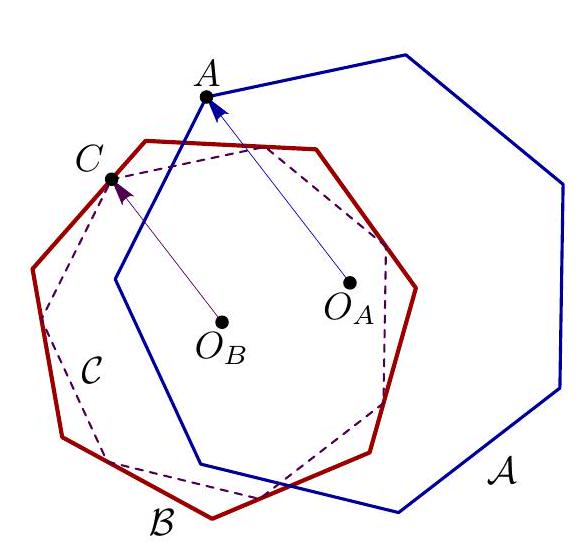
Construction of
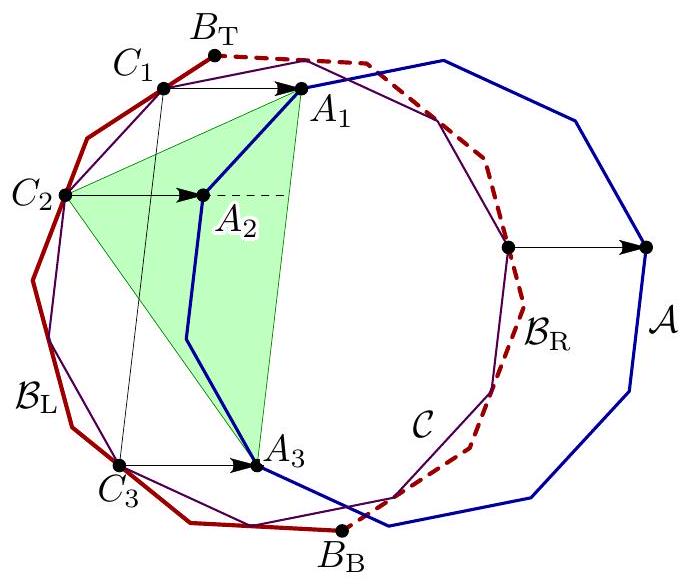
Case 1: Translation
Case 1: is a translation of by a vector .
Denote by the translation transform by vector . We need to prove that the vertices of which stay in under are consecutive. To visualize the argument, we refer the plane to Cartesian coordinates so that the -axis is co-directional with . This way, the notions of right/left and top/bottom are also introduced, according to the - and -coordinates, respectively.
Let and be the top and the bottom vertices of (if several vertices are extremal, we take the rightmost of them). They split the perimeter of into the right part and the left part (the vertices and are assumed to lie in both parts); each part forms a connected subset of the perimeter of . So the vertices of are also split into two parts and , each of which consists of consecutive vertices.
Now, all the points in (and hence in ) move out from under , since they are the rightmost points of on the corresponding horizontal lines. It remains to prove that the vertices of which stay in under are consecutive.
For this purpose, let , and be three vertices in such that is between and , and and lie in ; we need to prove that as well. Let . The line through parallel to crosses the segment to the right of ; this means that this line crosses to the right of , so lies inside the triangle which is contained in . This yields the desired result.
Case 2: is a homothetic image of centered at with factor .
Denote by the homothety mapping to . We need now to prove that the vertices of which stay in after applying are consecutive. If , the claim is easy. Indeed, if , then the vertices of lie on the segments of the form ( being a vertex of ) which lie in . If , then the vertices of lie on the extensions of such segments beyond , and almost all these extensions lie outside . The exceptions may occur only in case when lies on the boundary of , and they may cause one or two vertices of stay on the boundary of . But even in this case those vertices are still consecutive.
So, from now on we assume that .
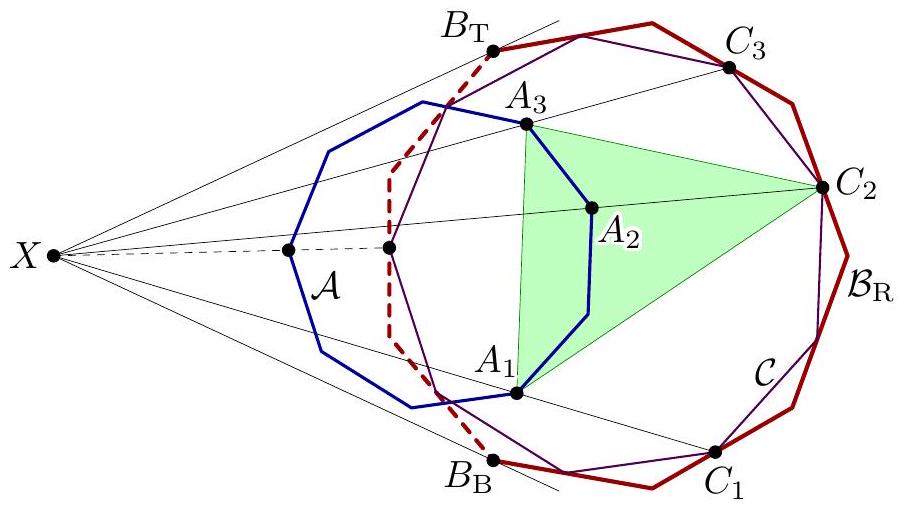
Now, there are two vertices and of such that is contained in the angle ; if there are several options, say, for , then we choose the farthest one from if , and the nearest one if . For the visualization purposes, we refer the plane to Cartesian coordinates so that the -axis is co-directional with , and lies to the left of the line . Again, the perimeter of is split by and into the right part and the left part , and the set of vertices of is split into two subsets and .
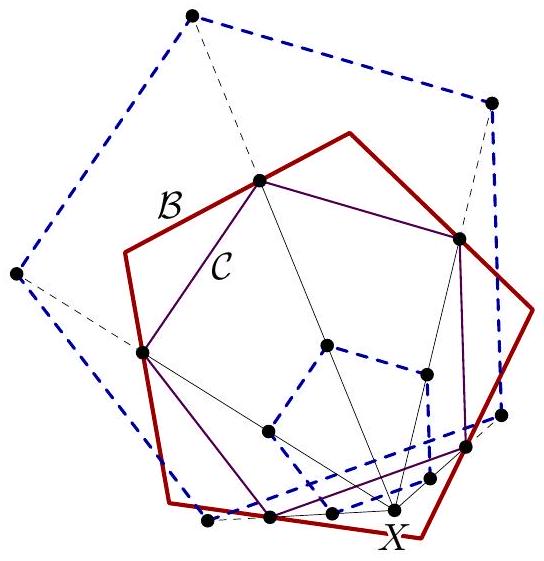
Case 2, inside
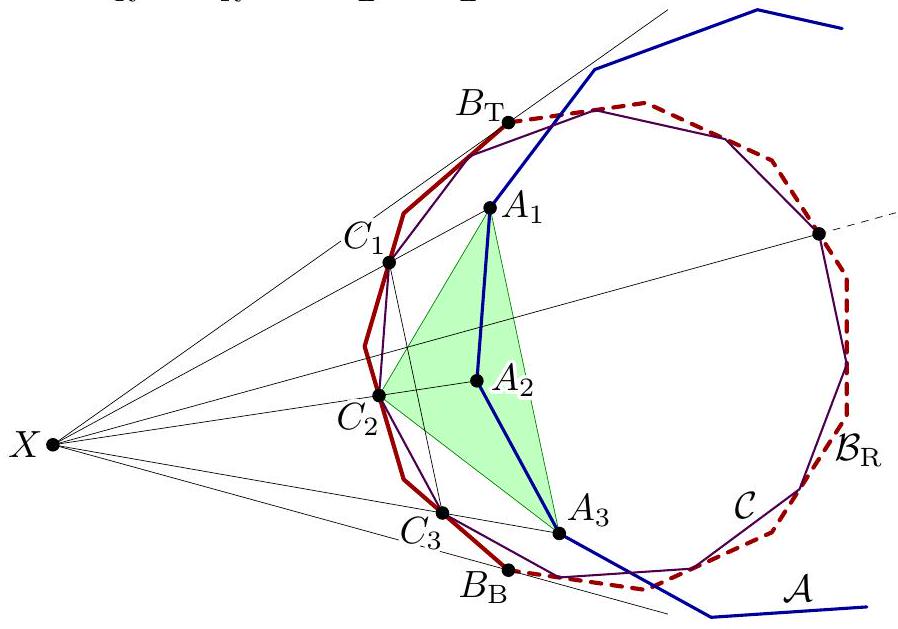
Subcase 2.1:
## Subcase 2.1: .
In this subcase, all points from (and hence from ) move out from under , because they are the farthest points of on the corresponding rays emanated from . It remains to prove that the vertices of which stay in under are consecutive.
Again, let be three vertices in such that is between and , and and lie in . Let . Then the ray crosses the segment beyond , so this ray crosses beyond ; this implies that lies in the triangle , which is contained in .
Subcase 2.2:
## Subcase 2.2: .
This case is completely similar to the previous one. All points from (and hence from ) move out from under , because they are the nearest points of on the corresponding rays emanated from . Assume that , and are three vertices in such that lies between and , and and lie in ; let . Then lies on the segment , and the segments and cross each other. Thus lies in the triangle , which is contained in .
Now, choose a vertex of such that the vector points "mostly outside "; strictly speaking, this means that the scalar product is minimal. Starting from , enumerate the vertices of clockwise as ; by the rotational symmetry, the choice of yields that the vector points "mostly outside ", i.e.,
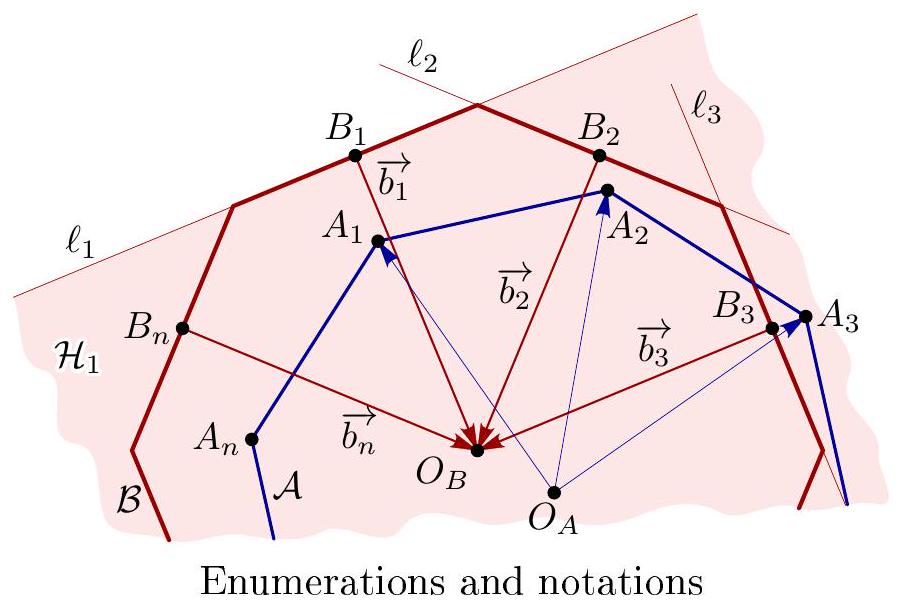
We intend to reformulate the problem in more combinatorial terms, for which purpose we introduce the following notion. Say that a subset is connected if the elements of this set are consecutive in the cyclic order (in other words, if we join each with by an edge, this subset is connected in the usual graph sense). Clearly, the union of two connected subsets sharing at least one element is connected too. Next, for any half-plane the indices of vertices of, say, that lie in form a connected set.
To access the problem, we denote
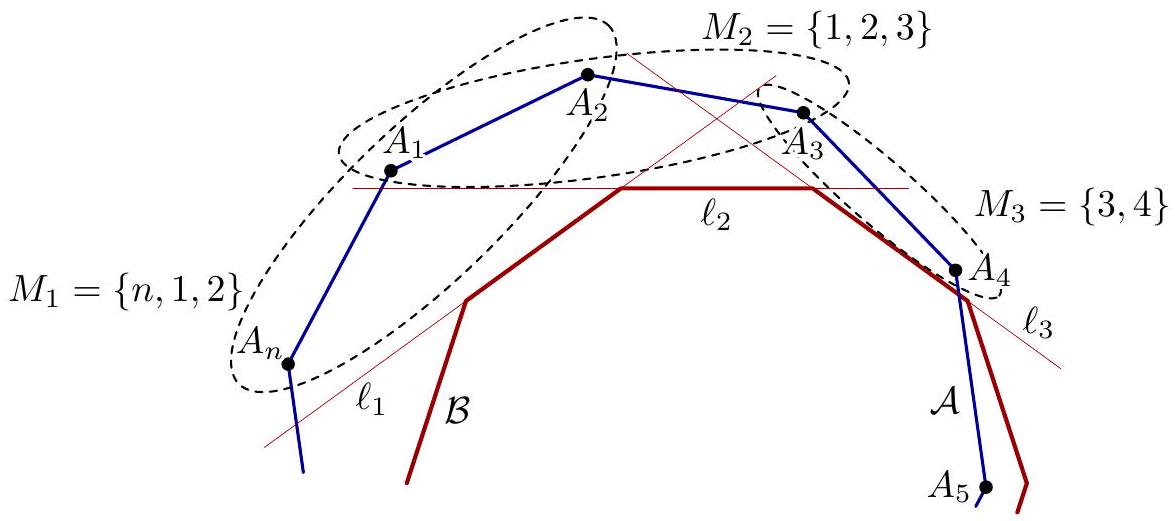
We need to prove that is connected, which is equivalent to being connected. On the other hand, since , we have , where the sets are easier to investigate. We will utilize the following properties of these sets; the first one holds by the definition of , along with the above remark.
The sets
Property 1: Each set is connected.
Property 2: If is nonempty, then .
Proof. Indeed, we have
The right-hand part of the last inequality does not depend on . Therefore, if some lies in , then by (1) so does .
In view of Property 2, it is useful to define the set
Property 3: The set is connected.
Proof. To prove this property, we proceed on with the investigation started in (2) to write
The right-hand part of the obtained inequality does not depend on , due to the rotational symmetry; denote its constant value by . Thus, if and only if . This condition is in turn equivalent to the fact that lies in a certain (open) half-plane whose boundary line is orthogonal to ; thus, it defines a connected set.
Now we can finish the solution. Since , we have
so can be obtained from by adding all the sets one by one. All these sets are connected, and each nonempty contains an element of (namely, ). Thus their union is also connected.
Want a route through all this instead of an archive? The track
puts 2,604 problems in a working order, from Junior Challenge level to the IMO shortlist.