Maths Olympiad Prep

Library / /26 of 39

Geometry Difficulty 6.3 National olympiad Prove it Romania

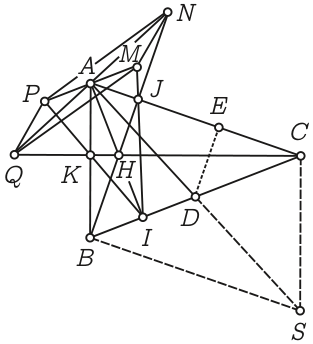
Let ABCABC be an acute triangle, with ABACAB \neq AC. Let DD be the midpoint of BCBC and I,J,KI, J, K be the feet of the altitudes from A,BA, B and CC, respectively, in the triangle ABCABC. The perpendicular from AA to the line ADAD meets the lines BJBJ and CKCK at points NN and QQ, respectively, and the parallel to BCBC through AA intersects the lines IJIJ and IKIK at MM and PP, respectively. Prove that MNPQMNPQ is a parallelogram.
Petru Braica

Figure 1

Solution

Let HH be the orthocenter of the triangle ABCABC. Quadrilaterals BIHKBIHK and CIHJCIHJ are cyclic, so HIK=HBK=ABJ=ACK=JCH=HIJ\angle HIK = \angle HBK = \angle ABJ = \angle ACK = \angle JCH = \angle HIJ.

Therefore, IAIA is the angle bisector of JIKJIK. Since IABCIA \perp BC and MPBCMP \parallel BC, it follows that IAMPIA \perp MP. Because IAIA is both an angle bisector and an altitude in IMP\triangle IMP, this triangle is isosceles and AA is the midpoint of MPMP. (*)

Let SS be the reflection point of AA with respect to point DD. Since DD is the midpoint of BCBC, it follows that ABSCABSC is a parallelogram. Consequently, BSACBS \parallel AC and, since BJACBJ \perp AC, we deduce that BJBSBJ \perp BS. From SBN=SAN=90\angle SBN = \angle SAN = 90^\circ it follows that SBANSBAN is cyclic, therefore NSA=ABN=90A\angle NSA = \angle ABN = 90^\circ - \angle A. Similarly, the quadrilateral SCAQSCAQ is cyclic, hence QSA=ACQ=90A=NSA\angle QSA = \angle ACQ = 90^\circ - \angle A = \angle NSA. In the triangle SNQSNQ, the altitude SASA is also an angle bisector, therefore AA is the midpoint of NQNQ. Since the diagonals of the quadrilateral MNPQMNPQ bisect each other, it follows that MNPQMNPQ is a parallelogram.

Alternative solution for ()*. Let EE be the projection of DD onto ACAC.
Since DEA=AJN=90\angle DEA = \angle AJN = 90^\circ and DAE=90NAJ=ANJ\angle DAE = 90^\circ - \angle NAJ = \angle ANJ, it follows that DAEANJ\triangle DAE \sim \triangle ANJ. Thus, NAAD=AJDE=2AJBJ\frac{NA}{AD} = \frac{AJ}{DE} = 2 \cdot \frac{AJ}{BJ}. Similarly, we obtain QAAD=2AKCK\frac{QA}{AD} = 2 \cdot \frac{AK}{CK}. The triangles ABJABJ and ACKACK are similar (AA), thus AJBJ=AKCK\frac{AJ}{BJ} = \frac{AK}{CK}, and consequently AQ=ANAQ = AN.

Want a route through all this instead of an archive? The track puts 2,000 problems in a working order, from AMC 10 level to the IMO shortlist.

Source: MathNet, licensed CC-BY-4.0. Statement and solution reproduced as published; topic and difficulty added by this site.