Maths Olympiad Prep

Library / /12 of 16

Geometry Difficulty 8.7 Shortlist Prove it IMO

Let the sides ADAD and BCBC of the quadrilateral ABCDABCD (such that ABAB is not parallel to CDCD) intersect at point PP. Points O1O_{1} and O2O_{2} are the circumcenters and points H1H_{1} and H2H_{2} are the orthocenters of triangles ABPABP and DCPDCP, respectively. Denote the midpoints of segments O1H1O_{1}H_{1} and O2H2O_{2}H_{2} by E1E_{1} and E2E_{2}, respectively. Prove that the perpendicular from E1E_{1} on CDCD, the perpendicular from E2E_{2} on ABAB and the line H1H2H_{1}H_{2} are concurrent.

Solutions — 2

Solution 1

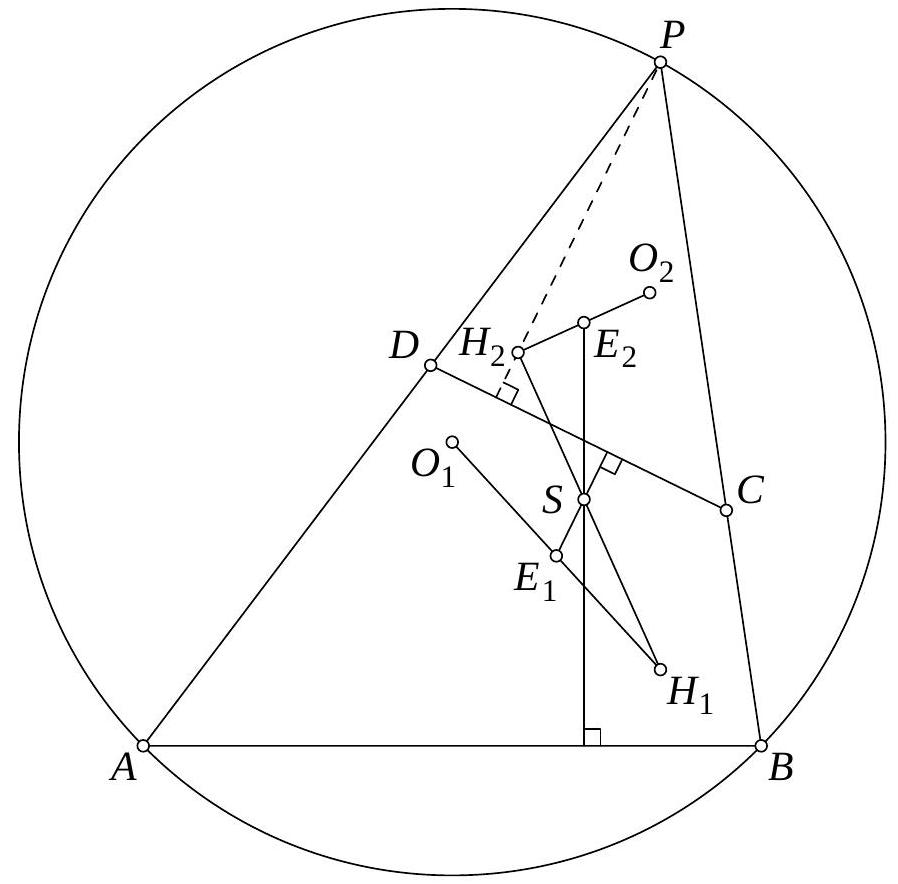
We keep triangle ABPABP fixed and move the line CDCD parallel to itself uniformly, i.e. linearly dependent on a single parameter λ\lambda (see Figure 1). Then the points CC and DD also move uniformly. Hence, the points O2,H2O_{2}, H_{2} and E2E_{2} move uniformly, too. Therefore also the perpendicular from E2E_{2} on ABAB moves uniformly. Obviously, the points O1,H1,E1O_{1}, H_{1}, E_{1} and the perpendicular from E1E_{1} on CDCD do not move at all. Hence, the intersection point SS of these two perpendiculars moves uniformly. Since H1H_{1} does not move, while H2H_{2} and SS move uniformly along parallel lines (both are perpendicular to CDCD), it is sufficient to prove their collinearity for two different positions of CDCD.

Figure 1
Figure 1

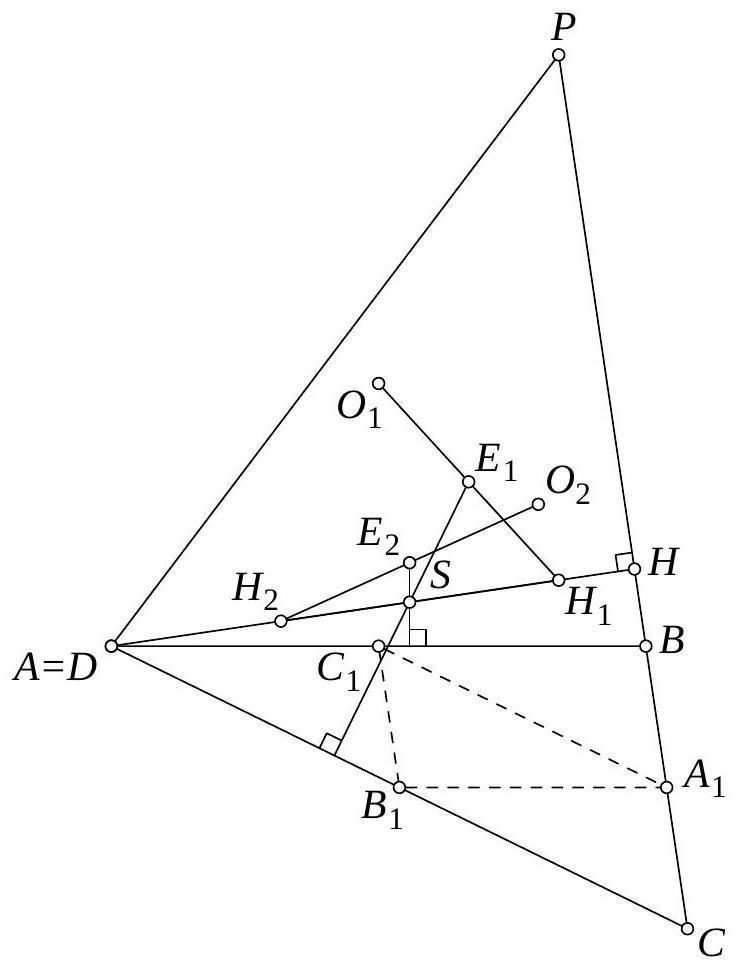
Let CDCD pass through either point AA or point BB. Note that by hypothesis these two cases are different. We will consider the case ACDA \in CD, i.e. A=DA = D. So we have to show that the perpendiculars from E1E_{1} on ACAC and from E2E_{2} on ABAB intersect on the altitude AHAH of triangle ABCABC (see Figure 2).

Figure 2
Figure 2

To this end, we consider the midpoints A1,B1,C1A_{1}, B_{1}, C_{1} of BC,CA,ABBC, CA, AB, respectively. As E1E_{1} is the center of FEUERBACH's circle (nine-point circle) of ABP\triangle ABP, we have E1C1=E1HE_{1}C_{1} = E_{1}H. Similarly, E2B1=E2HE_{2}B_{1} = E_{2}H. Note further that a point XX lies on the perpendicular from E1E_{1} on A1C1A_{1}C_{1} if and only if
XC12XA12=E1C12E1A12. XC_{1}^{2} - XA_{1}^{2} = E_{1}C_{1}^{2} - E_{1}A_{1}^{2}.
Similarly, the perpendicular from E2E_{2} on A1B1A_{1}B_{1} is characterized by
XA12XB12=E2A12E2B12 XA_{1}^{2} - XB_{1}^{2} = E_{2}A_{1}^{2} - E_{2}B_{1}^{2}
The line H1H2H_{1}H_{2}, which is perpendicular to B1C1B_{1}C_{1} and contains AA, is given by
XB12XC12=AB12AC12. XB_{1}^{2} - XC_{1}^{2} = AB_{1}^{2} - AC_{1}^{2}.
The three lines are concurrent if and only if
0=XC12XA12+XA12XB12+XB12XC12=E1C12E1A12+E2A12E2B12+AB12AC12=E1A12+E2A12+E1H2E2H2+AB12AC12 \begin{aligned} 0 & = XC_{1}^{2} - XA_{1}^{2} + XA_{1}^{2} - XB_{1}^{2} + XB_{1}^{2} - XC_{1}^{2} \\ & = E_{1}C_{1}^{2} - E_{1}A_{1}^{2} + E_{2}A_{1}^{2} - E_{2}B_{1}^{2} + AB_{1}^{2} - AC_{1}^{2} \\ & = -E_{1}A_{1}^{2} + E_{2}A_{1}^{2} + E_{1}H^{2} - E_{2}H^{2} + AB_{1}^{2} - AC_{1}^{2} \end{aligned}
i.e. it suffices to show that
E1A12E2A12E1H2+E2H2=AC2AB24 E_{1}A_{1}^{2} - E_{2}A_{1}^{2} - E_{1}H^{2} + E_{2}H^{2} = \frac{AC^{2} - AB^{2}}{4}
We have
AC2AB24=HC2HB24=(HC+HB)(HCHB)4=HA1BC2. \frac{AC^{2} - AB^{2}}{4} = \frac{HC^{2} - HB^{2}}{4} = \frac{(HC + HB)(HC - HB)}{4} = \frac{HA_{1} \cdot BC}{2}.
Let F1,F2F_{1}, F_{2} be the projections of E1,E2E_{1}, E_{2} on BCBC. Obviously, these are the midpoints of HP1HP_{1}, HP2HP_{2}, where P1,P2P_{1}, P_{2} are the midpoints of PBPB and PCPC respectively. Then
E1A12E2A12E1H2+E2H2=F1A12F1H2F2A12+F2H2=(F1A1F1H)(F1A1+F1H)(F2A1F2H)(F2A1+F2H)=A1H(A1P1A1P2)=A1HBC2=AC2AB24, \begin{aligned} & E_{1}A_{1}^{2} - E_{2}A_{1}^{2} - E_{1}H^{2} + E_{2}H^{2} \\ & = F_{1}A_{1}^{2} - F_{1}H^{2} - F_{2}A_{1}^{2} + F_{2}H^{2} \\ & = \left(F_{1}A_{1} - F_{1}H\right)\left(F_{1}A_{1} + F_{1}H\right) - \left(F_{2}A_{1} - F_{2}H\right)\left(F_{2}A_{1} + F_{2}H\right) \\ & = A_{1}H \cdot \left(A_{1}P_{1} - A_{1}P_{2}\right) \\ & = \frac{A_{1}H \cdot BC}{2} \\ & = \frac{AC^{2} - AB^{2}}{4}, \end{aligned}
which proves the claim.

Solution 2

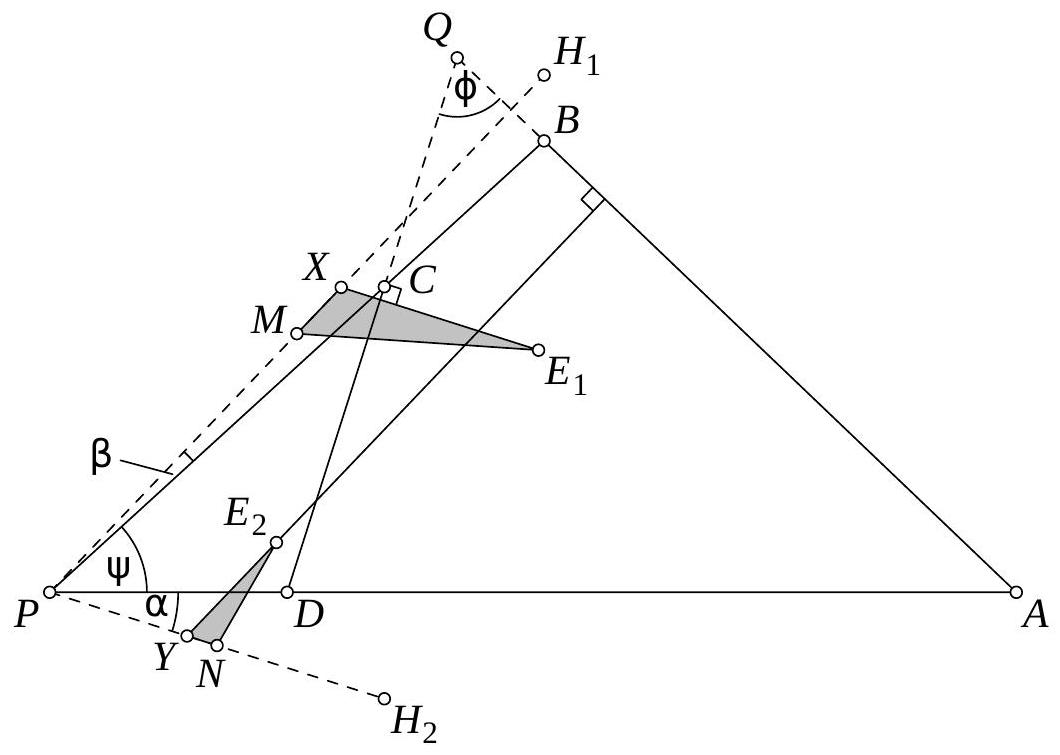
Let the perpendicular from E1E_{1} on CDCD meet PH1PH_{1} at XX, and the perpendicular from E2E_{2} on ABAB meet PH2PH_{2} at YY (see Figure 3). Let φ\varphi be the intersection angle of ABAB and CDCD. Denote by M,NM, N the midpoints of PH1,PH2PH_{1}, PH_{2} respectively.

Figure 3
Figure 3

We will prove now that triangles E1XME_{1}XM and E2YNE_{2}YN have equal angles at E1,E2E_{1}, E_{2}, and supplementary angles at X,YX, Y.
In the following, angles are understood as oriented, and equalities of angles modulo 180180^{\circ}.
Let α=H2PD\alpha = \angle H_{2}PD, ψ=DPC\psi = \angle DPC, β=CPH1\beta = \angle CPH_{1}. Then α+ψ+β=φ\alpha + \psi + \beta = \varphi, E1XH1=H2YE2=φ\angle E_{1}XH_{1} = \angle H_{2}YE_{2} = \varphi, thus MXE1+NYE2=180\angle MXE_{1} + \angle NYE_{2} = 180^{\circ}.
By considering the Feuerbach circle of ABP\triangle ABP whose center is E1E_{1} and which goes through MM, we have E1MH1=ψ+2β\angle E_{1}MH_{1} = \psi + 2\beta. Analogous considerations with the Feuerbach circle of DCP\triangle DCP yield H2NE2=ψ+2α\angle H_{2}NE_{2} = \psi + 2\alpha. Hence indeed XE1M=φ(ψ+2β)=(ψ+2α)φ=YE2N\angle XE_{1}M = \varphi - (\psi + 2\beta) = (\psi + 2\alpha) - \varphi = \angle YE_{2}N. It follows now that
XMME1=YNNE2. \frac{XM}{ME_{1}} = \frac{YN}{NE_{2}}.
Furthermore, ME1ME_{1} is half the circumradius of ABP\triangle ABP, while PH1PH_{1} is the distance of PP to the orthocenter of that triangle, which is twice the circumradius times the cosine of ψ\psi. Together with analogous reasoning for DCP\triangle DCP we have
ME1PH1=14cosψ=NE2PH2. \frac{ME_{1}}{PH_{1}} = \frac{1}{4 \cos \psi} = \frac{NE_{2}}{PH_{2}}.
By multiplication,
XMPH1=YNPH2, \frac{XM}{PH_{1}} = \frac{YN}{PH_{2}},
and therefore
PXXH1=H2YYP. \frac{PX}{XH_{1}} = \frac{H_{2}Y}{YP}.
Let E1X,E2YE_{1}X, E_{2}Y meet H1H2H_{1}H_{2} in R,SR, S respectively.
Applying the intercept theorem to the parallels E1X,PH2E_{1}X, PH_{2} and center H1H_{1} gives
H2RRH1=PXXH1, \frac{H_{2}R}{RH_{1}} = \frac{PX}{XH_{1}},
while with parallels E2Y,PH1E_{2}Y, PH_{1} and center H2H_{2} we obtain
H2SSH1=H2YYP \frac{H_{2}S}{SH_{1}} = \frac{H_{2}Y}{YP}
Combination of the last three equalities yields that RR and SS coincide.

Want a route through all this instead of an archive? The track puts 2,000 problems in a working order, from AMC 10 level to the IMO shortlist.

Source: MathNet, licensed CC-BY-4.0. Statement and solution reproduced as published; topic and difficulty added by this site.