The opposite sides of a convex hexagon of unit area are pairwise parallel. The lines of support of three alternate sides meet pairwise to form a triangle. Similarly, the lines of support of the other three alternate sides meet pairwise to form another triangle. Show that the area of at least one of these two triangles is greater than or equal to .
ShortlistBMO, 2011
Solution
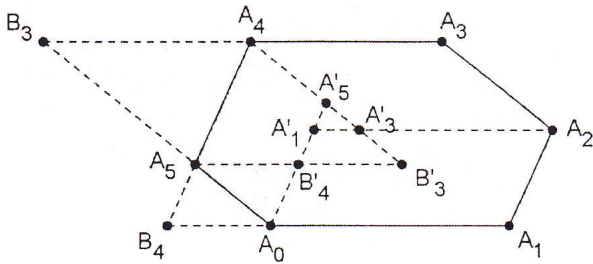
Unless otherwise stated, throughout the proof indices take on values from to and are reduced modulo . Label the vertices of the hexagon in circular order, , and let the lines of support of the alternate sides and meet at . To show that the area of at least one of the triangles , is greater than or equal to , it is sufficient to prove that the total area of the six triangles is at least :
To begin with, reflect each through the midpoint of the segment to get the points . We shall prove that the six triangles cover the hexagon. To this end, reflect through the midpoint of the segment to get the points , . The hexagon splits into three parallelograms, , , and a (possibly degenerate) triangle, . Notice first that each parallelogram is covered by the pair of triangles , . The proof is completed by showing that at least one of these pairs contains a triangle that covers the triangle . To this end, it is sufficient to prove that and for some indices . To establish the first inequality, notice that
to get
Similarly,
whence the conclusion.
Want a route through all this instead of an archive? The track
puts 2,604 problems in a working order, from Junior Challenge level to the IMO shortlist.