Consider a triangle with incenter . Let be the intersection point of and , and let intersect the circumcircle of at . Point lies on the line such that . Let be the reflection of with respect to . Prove that is cyclic.
Iranian Mathematical Olympiad
Solution
Let be the intersection point of line and the circumcircle of , then, since and , so , it follows that the points , , , lie on a circle. Suppose intersects this circle at point , other than . Let be the intersection point of line and the circumcircle of and be where lines and meet.
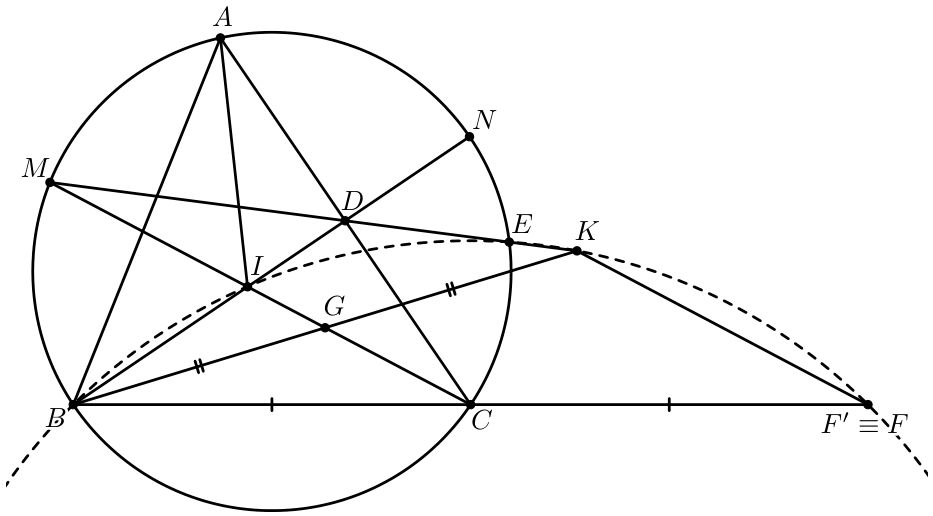
Since , noting the parallel lines, we have
Now we have
and
so we have
On the other hand, since we have
So we get
and that easily gives us . Then we have and since we have so . Thus, is cyclic as desired. ■
Want a route through all this instead of an archive? The track
puts 2,604 problems in a working order, from Junior Challenge level to the IMO shortlist.