Maths Olympiad Prep

Library / /5 of 5

Geometry Difficulty 8.8 Shortlist Prove it Slovenia

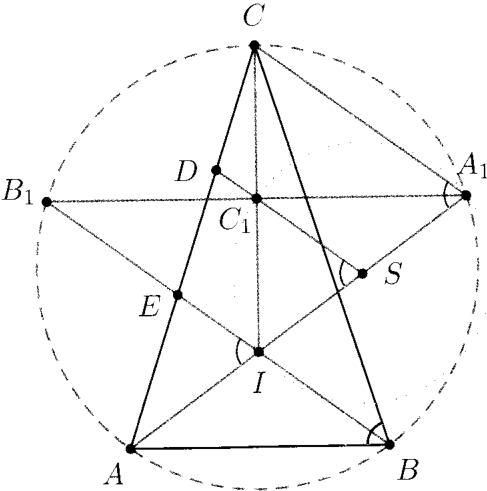
Let ABCABC be an acute triangle and let II be the incentre of the triangle ABCABC. The lines AIAI and BIBI meet the circumcircle of the triangle ABCABC again at A1A_1 and B1B_1. The segments A1B1A_1B_1 and CICI meet at C1C_1. Let SS be the circumcentre of the triangle IA1C1IA_1C_1. The lines SC1SC_1 and BIBI meet the segment ACAC at DD and EE. Find the angles of the triangle ABCABC if CD=DE|CD| = |DE| and CBA=2ACB\angle CBA = 2\angle ACB.

Solution

Let us write ACB=γ\angle ACB = \gamma. Then CBA=2γ\angle CBA = 2\gamma and BAC=π3γ\angle BAC = \pi - 3\gamma. If we draw a figure where CBA=2ACB\angle CBA = 2\angle ACB, we notice that IA1C1IA_1C_1 is a right triangle. Let us prove this.
Since ABA1B1ABA_1B_1 is a cyclic quadrilateral we have C1A1I=B1A1A=B1BA=BCA2=γ\angle C_1A_1I = \angle B_1A_1A = \angle B_1BA = \frac{\angle BCA}{2} = \gamma. The angle A1IC\angle A_1IC is equal to πCIA\pi - \angle CIA. Since CIA=πCAIACI\angle CIA = \pi - \angle CAI - \angle ACI, we get
A1IC=CAI+ACI=π3γ2+γ2=π2γ. \angle A_1IC = \angle CAI + \angle ACI = \frac{\pi - 3\gamma}{2} + \frac{\gamma}{2} = \frac{\pi}{2} - \gamma.
Figure 1
So, A1IC+C1A1I=π2\angle A_1IC + \angle C_1A_1I = \frac{\pi}{2} and IC1A1=π2\angle IC_1A_1 = \frac{\pi}{2}. Thales' theorem states that the circumcentre of the triangle IA1C1IA_1C_1 (i.e. the point S) is the midpoint of the segment IA1IA_1. The central angle is twice the inscribed angle, so C1SI=2C1A1I=2CBA2=2γ\angle C_1SI = 2\angle C_1A_1I = 2\frac{\angle CBA}{2} = 2\gamma. The quadrilateral ABA1C1ABA_1C_1 is cyclic, so CA1A=CBA=2γ\angle CA_1A = \angle CBA = 2\gamma. Hence, CA1CA_1 is parallel to DS. But D is the midpoint of the segment CE and S is the midpoint of the segment IA1IA_1, so DS is the midsegment of the quadrilateral SIA1C1SIA_1C_1. Since DS is parallel to CA1CA_1 it must also be parallel to EI. So, EIA=DSA=2γ\angle EIA = \angle DSA = 2\gamma.

For the inner angles of the triangle ABI we have BAI=BAC=π3γ2\angle BAI = \angle BAC = \frac{\pi-3\gamma}{2}, IBA=CBA=π3γ2\angle IBA = \angle CBA = \frac{\pi-3\gamma}{2}. Since the sum of the inner angles in an arbitrary triangle is equal to π\pi we get π3γ2+γ+π2γ=π\frac{\pi-3\gamma}{2} + \gamma + \pi - 2\gamma = \pi or γ=π5\gamma = \frac{\pi}{5}.

The angles of the triangle ABC measure BAC=CBA=2π5\angle BAC = \angle CBA = \frac{2\pi}{5} and ACB=π5\angle ACB = \frac{\pi}{5}.

Want a route through all this instead of an archive? The track puts 2,000 problems in a working order, from AMC 10 level to the IMO shortlist.

Source: MathNet, licensed CC-BY-4.0. Statement and solution reproduced as published; topic and difficulty added by this site.