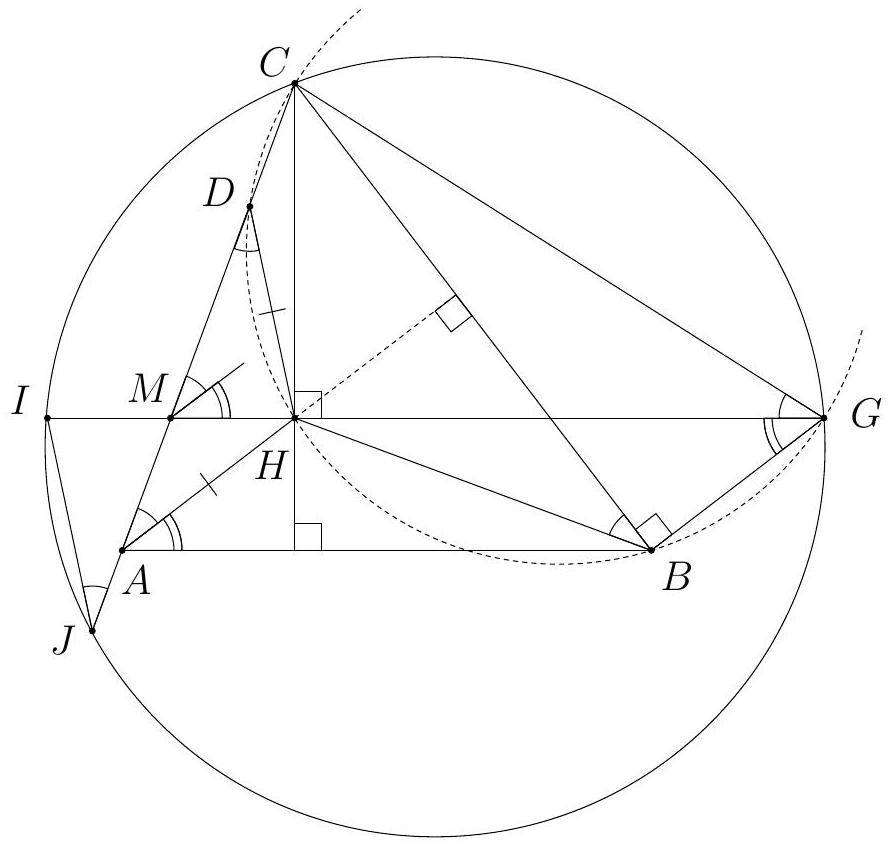
Let ABC be an acute triangle with orthocenter H. Let G be the point such that the quadrilateral ABGH is a parallelogram. Let I be the point on the line GH such that AC bisects HI. Suppose that the line AC intersects the circumcircle of the triangle GCI at C and J. Prove that IJ=AH. (Australia)
Solutions — 2
Solution 1
Since HG∥AB and BG∥AH, we have BG⊥BC and CH⊥GH. Therefore, the quadrilateral BGCH is cyclic. Since H is the orthocenter of the triangle ABC, we have ∠HAC=90∘−∠ACB=∠CBH. Using that BGCH and CGJI are cyclic quadrilaterals, we get ∠CJI=∠CGH=∠CBH=∠HAC. Let M be the intersection of AC and GH, and let D=A be the point on the line AC such that AH=HD. Then ∠MJI=∠HAC=∠MDH. Since ∠MJI=∠MDH, ∠IMJ=∠HMD, and IM=MH, the triangles IMJ and HMD are congruent, and thus IJ=HD=AH.
Solution 2
Obtain ∠CGH=∠HAC as in the previous solution. In the parallelogram ABGH we have ∠BAH=∠HGB. It follows that ∠HMC=∠BAC=∠BAH+∠HAC=∠HGB+∠CGH=∠CGB. So the right triangles CMH and CGB are similar. Also, in the circumcircle of triangle GCI we have similar triangles MIJ and MCG. Therefore, CGIJ=MCMI=MCMH=GCGB=CGAH. Hence IJ=AH.
Want a route through all this instead of an archive? The track
puts 2,604 problems in a working order, from Junior Challenge level to the IMO shortlist.
Source: MathNet,
licensed CC-BY-4.0.
Statement reproduced verbatim; metadata (topic, difficulty) added by this project.