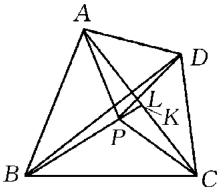
In a convex quadrilateral ABCD, the diagonal BD bisects neither the angle ABC nor the angle CDA. The point P lies inside ABCD and satisfies ∠PBC=∠DBA and ∠PDC=∠BDA.
Prove that ABCD is a cyclic quadrilateral if and only if AP=CP.
Solution
(i) Necessity.
Assume that ABCD is a cyclic quadrilateral. Let the circle Γ be the circumcircle of quadrilateral ABCD. Extend BP and DP beyond P to meet the circle Γ at X and Y respectively.
Since DB does not bisect ∠ABC and P lies inside ABCD, it follows from ∠PBC=∠DBA that CX=AD, D=X, and the points D and X lie in the same half-plane bounded by the line AC. Hence DX∥AC. Similarly, B=Y and BY∥AC.
The points D, X, A, C, B, Y lie on the circle Γ, as mentioned above. So the points D and X, the points A and C, the points B and Y are symmetrical with respect to the perpendicular bisector l of AC respectively.
Since P=DY∩BX, then P is on the line l, or AP=CP. This completes the proof of the necessity.
(ii) Sufficiency.
Lemma. Let l be a fixed line and A,B,C be fixed points such that A and B, C lie in the different half-planes bounded by the line l. Assume that the point X lies on the line l. Let α(X) be the smallest angle of rotation from the line XA to the line l anticlockwise. Let β(X) be the smallest angle of rotation from the line XC to the line XB anticlockwise. If α(X)=β(X), then X is called a good point. Prove that there are at most two good points.
Proof of the lemma
We set up a coordinate system with the line l as the x-axis and the perpendicular of l as the y-axis. Let A(a,b), B(c,d), C(e,f), X(x,0). Then A=a+bi, B=c+di, C=e+fi, and X=x. Hence A−X(a−x+bi)(cosα(X)+isinα(X))=a−x+bi,=(a−x)cosα(X)−bsinα(X)+[(a−x)sinα(X)+bcosα(X)]i.
Rotate the line XA by α(X) anticlockwise, coinciding with l. So (a−x)cosα(X)+bcosα(X)=0(1)
Moreover, since XC=e−x+fi, XB=c−x+di, then XC after being rotated by β(X) anticlockwise becomes (e−x+fi)(cosβ(X)+isinβ(X))=(e−x)cosβ(X)−fsinβ(X)+[(e−x)sinβ(X)+fcosβ(X)]i which is parallel to XB. Thus, (c−x)[(e−x)sinβ(X)+fcosβ(X)]−d[(e−x)cosβ(X)−fsinβ(X)]=0, and [(c−x)(e−x)+df]sinβ(X)+[(c−x)f−d(e−x)]cosβ(X)=0.(2)
Since sinθ and cosθ are not 0 at the same time, so X is a good point ⇔α(X)=β(X)⇔ the simultaneous equations in u and v. {(a−x)u+bv=0,[(c−x)(e−x)+df]u+[(c−x)f−d(e−x)]v=0 have the non-zero solutions ⇔b[(c−x)(e−x)+df]+(a−x)[(c−x)f−d(e−x)]=0⇔(b+d−f)x2+(af+cf−bc−be−ad−ed)x⇔(b+d−f)x2+(af+cf−bc−be−ad−ed)x+bce+bdf+ade−acf=0.
Let g(x)=(b+d−f)x2+(af+cf−bc−be−ad−ed)x+bce+bdf+ade−acf. If b+d−f=0, it follows from b=0 that d=f. Hence BC and l are not parallel. Let BC intersect l at T(t,0). We have that β(T)=0 and α(T)>0. Hence T is not a good point. This implies g(t)=0, so the equation g(x)=0 has at most two solutions.
Hence there are at most two good points.
This completes the proof of the lemma.
Let the points A, B, C, D be arranged clockwise and AP=CP. Let D∗ be the point such that A, D∗, C, B are concyclic, where D∗ lies on the ray BD. Since AP=CP and BD bisects neither ∠ABC nor ∠ADC, BP intersects the perpendicular bisector of AC at the unique point P.
Let D∗R be the ray satisfying ∠CD∗R=∠AD∗B and P∗=D∗R∩BP. Together with (i), we have that P∗A=P∗C, or P∗ is the intersection point of l and the perpendicular bisector of AC, so P∗=P. It follows from ∠CD∗R=∠AD∗B that ∠AD∗B=∠CD∗P.
Replace l, A, B, C by BD, A, C, P. Then B, D, D∗ are good points. Since B=D and B=D∗, D=D∗. Hence A, B, C, D is concyclic.
This completes the proof of the sufficiency.
Solution II
We may assume without loss of generality that P lies in the rectangles ABC and BCD.
Assume that the quadrilateral ABCD is cyclic. Let the lines BP and DP meet AC at K and L respectively. It follows from the given equalities and ∠ACB=∠ADB, ∠ABD=∠ACD that the triangles DAB, DLC and CKB are similar. This implies ∠DLC=∠CKB, so ∠PLK=∠PKL. Hence PK=PL.
It follows from ∠BDA=∠PDC that ∠ADL=∠BDC. Since ∠DAL=∠DBC, the triangles ADL and BDC are similar. Hence BCAL=BDAD=BCKC, yielding AL=KC. It follows from ∠DLC=∠CKB that ∠ALP=∠CKP. Moreover, since PK=PL and AL=KC, the triangles ALP and CKP are congruent. Hence AP=CP.
Want a route through all this instead of an archive? The track
puts 2,604 problems in a working order, from Junior Challenge level to the IMO shortlist.
Source: MathNet,
licensed CC-BY-4.0.
Statement reproduced verbatim; metadata (topic, difficulty) added by this project.