1920
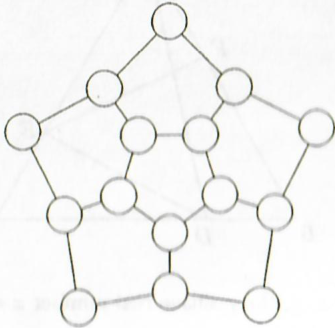
A line segment for which the difference between the numbers written in the two circles at its endpoints is 1 is called a good line segment, and one that does not satisfy this condition is called a bad line segment. Let us also name the six pentagons as P1 to P6, as shown in the figure below.
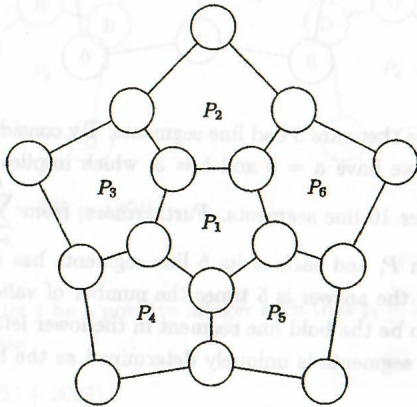
Lemma. Among the five line segments that form a pentagon, at least one is a bad line segment.
Proof. Assume that all five line segments are good line segments, and we will show a contradiction. Let a,b,c,d,e be the numbers written in the circles of the pentagon in clockwise order. Since we are assuming that all line segments are good, we have a−b,b−c,c−d,d−e, and e−a are all odd numbers. Thus, their sum is also odd. However, this sum is equal to 0, which is a contradiction. ■
For each pentagon Pi, let bi be the number of bad line segments among the five line segments that form it. From the lemma, we know that bi≥1 for all i. Let a be the number of bad line segments among the ten line segments on the outer border, and let b be the number of bad line segments among the remaining ten line segments. Then, we have a+2b=∑i=16bi. Thus, we have a+2b≥6, which implies a+b≥2a+2b≥3. Therefore, there are at least three bad line segments in total. Conversely, if we label circles in the following way, there are exactly three bad line segments (shown bold), satisfying the given conditions. Therefore, the maximum value M of beauty is 20−3=17.
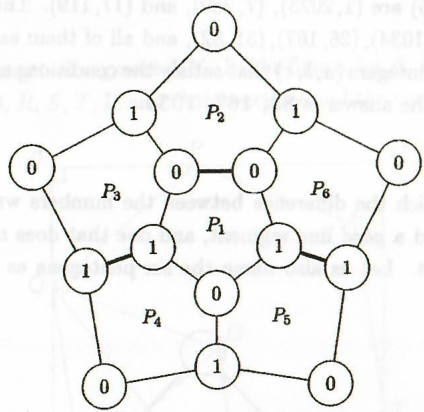
Consider the case where there are 3 bad line segments. By considering the equality condition of the inequality above, we have a=0 and b=3, which implies that there are no bad line segments among the outer 10 line segments. Furthermore, from ∑i=16bi=a+2b=6, we have bi=1 for each pentagon Pi and each of its 5 line segments has exactly 1 bad line segment. Therefore, by symmetry, the answer is 5 times the number of valid labelings when we fix one bad line segment of P1 to be the bold line segment in the lower left figure. When we fix it, the arrangement of bad line segments is uniquely determined as the bold line segments shown in the lower right figure.
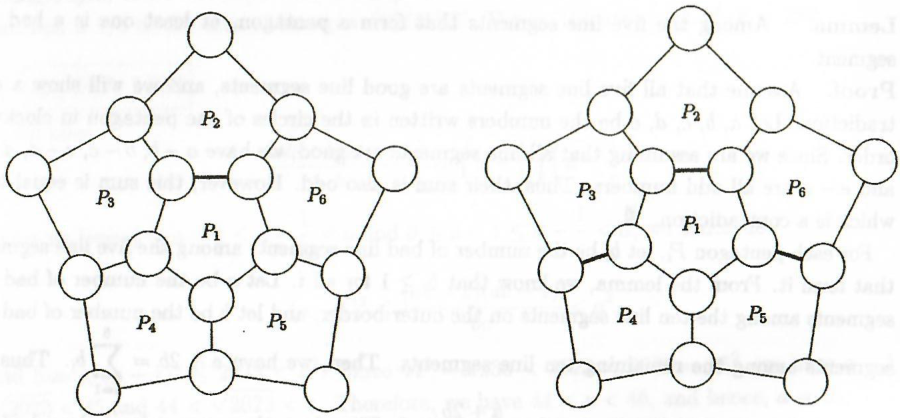
Note that the only allowed odd number is 1, a good line segment must have different parity between the ends and vice versa. Hence, the parity of labeling must be one of the following two patterns, and conversely, any labelling consistent with these patterns satisfies the condition.
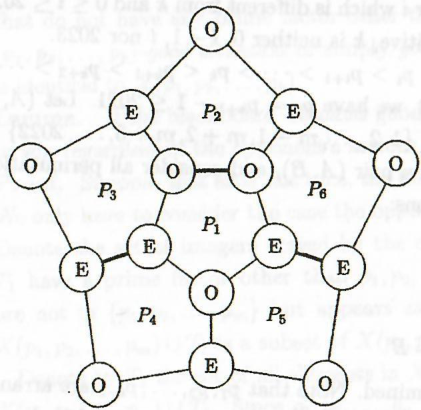
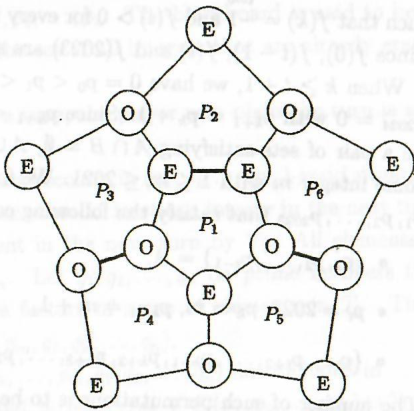
There are two even numbers allowed, so there are 27 ways to fill in the left pattern and 28 ways to fill in the right pattern, for a total of 27+28=384 ways.
Therefore, the answer is 5×384=1920.