Maths Olympiad Prep

Library / /4 of 6

Geometry Difficulty 8.6 Shortlist Prove it Vietnam

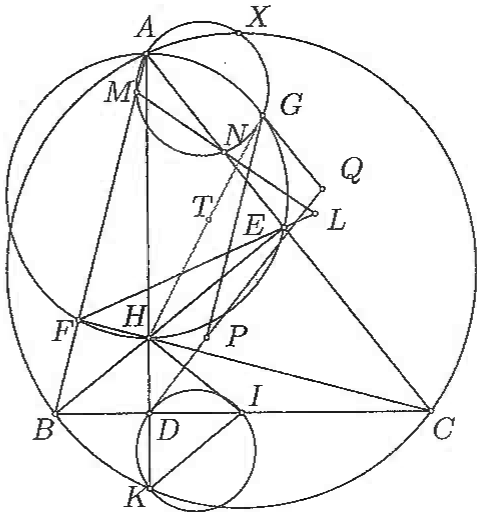
Given a fixed circle (OO) and two fixed points B,CB, C on that circle, let AA be a moving point on (OO) such that triangle ABCABC is acute and scalene. Let II be the midpoint of BCBC and let AD,BEAD, BE and CFCF be the altitudes of triangle ABCABC. On two rays FA\overrightarrow{FA}, EA\overrightarrow{EA}, take M,NM, N such that FM=CEFM = CE, EN=BFEN = BF. Let LL be the intersection of MNMN and EFEF, and let GLG \neq L be the second intersection of the circumcircles of triangles LENLEN and LFMLFM.

a) Show that the circumcircle of triangle MNGMNG always goes through a fixed point.

b) Let ADAD intersects (OO) at KK which is differs from AA. On the tangent line through DD of circumcircle of DKIDKI, take P,QP, Q such that GPGP is parallel to ABAB and GQGQ is parallel to ACAC. Let TT be the circumcenter of triangle GPQGPQ. Show that GTGT always goes through a fixed point.

Solution

a)
It is clear that GG is the Miquel point of completed quadrilateral MNEF.LAMNEF.LA, thus GG lies on the circumcircle of AMN\triangle AMN, AEF\triangle AEF. Besides,

BM=BF+FM=EN+CE=CN. BM = BF + FM = EN + CE = CN.

Figure 1

Let XX be the midpoint of arc BACBAC of (O)(O) then XBM=XCN\triangle XBM = \triangle XCN. Hence, XMA=XNA\angle XMA = \angle XNA; it follows that XX lies on the circumcircle of AMNAMN, in other words, (GMN)(GMN) passes through fixed point XX.

b)
Let HH be the orthocenter of ABC\triangle ABC. Since GG lies on the circumcircle of AMN\triangle AMN, AEF\triangle AEF, we have GMFGNE\triangle GMF \sim \triangle GNE, thus
GEGF=NEMF=BFCE=HFHE \frac{GE}{GF} = \frac{NE}{MF} = \frac{BF}{CE} = \frac{HF}{HE}
This means GHGH bisects EFEF. Since EFEF and BCBC are anti-parallel with respect to BHC\angle BHC, therefore HGHG is the symmedian of HBC\triangle HBC. It is well known that KK and HH are symmetric with respect to BCBC. Thus PDI=DKI=DHI\angle PDI = \angle DKI = \angle DHI, we obtain that PQHIPQ \perp HI. Therefore,
HGQ=90GHE=90CHI=90GPQ=TGQ. \angle HGQ = 90^\circ - \angle GHE = 90^\circ - \angle CHI \\ = 90^\circ - \angle GPQ = \angle TGQ.
Hence, GG, HH and TT are collinear. It is clear that (BHC)(BHC) is fixed circle since BHC=180BAC\angle BHC = 180^\circ - \angle BAC. Thus, HTHT passes through the intersection of tangents at BB, CC of (BHC)(BHC) which is fixed. \square

Want a route through all this instead of an archive? The track puts 2,000 problems in a working order, from AMC 10 level to the IMO shortlist.

Source: MathNet, licensed CC-BY-4.0. Statement and solution reproduced as published; topic and difficulty added by this site.