Olympiad Maths Prep

Library / /15 of 28

Geometry Difficulty 5.6 AIME, harder Prove it Ukraine

In triangle ABCABC points MM and NN are the midpoints of the sides BCBC and ACAC respectively. Inside ABC\triangle ABC a point PP is taken such that BAP=PBC=PCA\angle BAP = \angle PBC = \angle PCA. It is known that PNA=AMB\angle PNA = \angle AMB. Prove that ABCABC is an isosceles triangle.

Solutions — 2

Solution 1

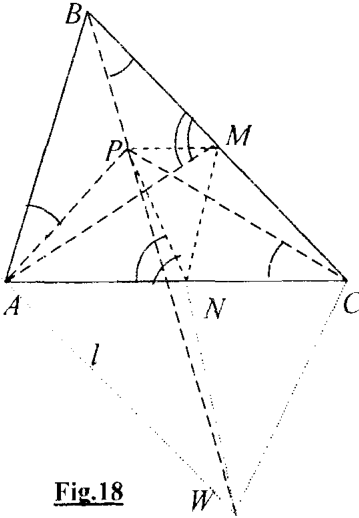
Let us draw the line lBCl \parallel BC through the point AA and denote W=BPlW = BP \cap l. Then

BPC=180(PBC+PCB)=\angle BPC = 180^\circ - (\angle PBC + \angle PCB) =
180(PCA+PCB)=180BCA180^\circ - (\angle PCA + \angle PCB) = 180^\circ - \angle BCA \Rightarrow
CPW=CAW\angle CPW = \angle CAW. And so points A,P,C,WA, P, C, W are cyclic. Thus AWC=180APC\angle AWC = 180^\circ - \angle APC,
APC=180(PAC+PCA)=\angle APC = 180^\circ - (\angle PAC + \angle PCA) =
180(PAC+PAB)=180BAC180^\circ - (\angle PAC + \angle PAB) = 180^\circ - \angle BAC, and
it follows that (fig.17) AWC=\angle AWC =
180APC=BAC180^\circ - \angle APC = \angle BAC. Now AWCBAW \parallel CB implies
that WAC=BCA\angle WAC = \angle BCA. And so ABCACW\triangle ABC \sim \triangle ACW.
Since M,NM, N are the midpoints of the corresponding sides of similar triangles we have that
WNA=AMC\angle WNA = \angle AMC \Rightarrow
WNA+ANP=AMC+AMB=180\angle WNA + \angle ANP = \angle AMC + \angle AMB = 180^\circ. And so
B,P,N,WB, P, N, W lie on the same line.
Therefore BNA=BMA\angle BNA = \angle BMA, which implies that
A,B,M,NA, B, M, N are cyclic. Since MNABMN \parallel AB as the centerline, ABMNABMN is an isosceles trapezoid, whence
AN=BMAC=BCAN = BM \Rightarrow AC = BC, what was to be proved.

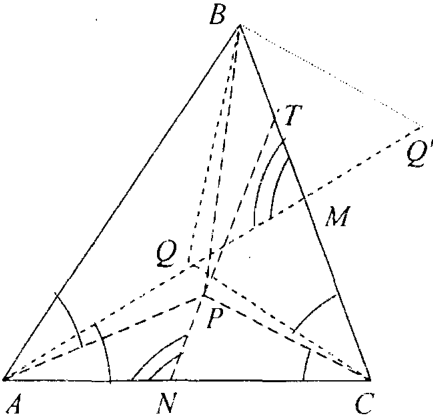
Figure 1
Fig.17

Solution 2

Let QQ be a point of the median AMAM such that QCB=PCA\angle QCB = \angle PCA. Since QMB=PNA\angle QMB = \angle PNA we have that QMC=PNC\angle QMC = \angle PNC and so PNCQMC\triangle PNC \sim \triangle QMC. From this similarity PCCQ=CNCM=BCAC\frac{PC}{CQ} = \frac{CN}{CM} = \frac{BC}{AC} and thus QCBPCA\triangle QCB \sim \triangle PCA. Then we can obtain that (fig.18) BQC=APC=\angle BQC = \angle APC =
Figure 2
Fig.18

PACPCA=180PAC+PABPCA=180BAC\angle PAC - \angle PCA = 180^\circ - \angle PAC + \angle PAB - \angle PCA = 180^\circ - \angle BAC. Now let QQ' be symmetric to QQ with respect to MM. Then BQCQBQCQ' is a parallelogram and BQC=BQC=180BAC\angle BQ'C = \angle BQC = 180^\circ - \angle BAC. From this it also follows that the quadrilateral ABQCABQ'C is cyclic and so MAC=QAC=QBC=OBC\angle MAC = \angle Q'AC = \angle Q'BC = \angle OBC. Denote T=NPBCT = NP \cap BC. Then the triangles NTCNTC and MACMAC are similar and thus PTC=NTC=MAC=PBC\angle PTC = \angle NTC = \angle MAC = \angle PBC. Points TT and BB lie on the circumcircle of the triangle PBCPBC, and also on the line BCBC. Therefore TT coincides with one of the points BB or CC. It is evident that TT cannot coincide with CC, so T=BT=B, which means that the points N,PN, P and BB lie on a line. Since ANB=ANP=AMB\angle ANB = \angle ANP = \angle AMB, points A,N,MA, N, M and BB are cyclic, and it follows that CNNA=CMCBCN \cdot NA = CM \cdot CB, which implies that CA=CBCA = CB, i.e. that ABCABC is an isosceles triangle.

Looking for a route rather than an archive? The track puts 2,000 problems in a working order, from AMC 10 level to the IMO shortlist.

Source: MathNet, licensed CC-BY-4.0. Statement and solution reproduced as published; topic and difficulty added by this site.