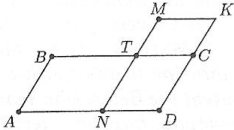
Construct the segment AK. By condition, T lies on AK. Let R be the intersection point of lines DT and KM (see the figures). Let AN=x, ND=y, RM=z, AT:TK=1:k. By Thales' theorem, k=TK:AT=y:x (since NT∥DK). Since NMKD is a parallelogram, we have MK=ND=y, and then
z:y=RM:MK=[TM∥DK]=RT:TD=[TC∥RK]=KC:CD=
=[TC∥AD]=KT:TA=k.(1)
So, y=kx, z=ky=k2x. Let P1 be the point of intersection of AM and RD (Fig. 1).
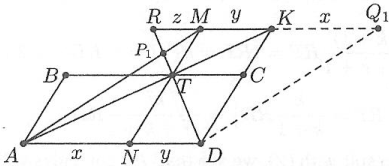
Construct a line passing through A parallel to AM, and let Q1 be the point of intersection of this line and the line MK. By Thales' theorem,
RP1:P1D=RM:MQ1=[AMQ1D is a parallelogram,MQ1=AD=x+y]=z:(x+y)=k2x:(x+kx)=1+kk2.
Therefore,
RP1=1+kk2P1D=1+kk2(RD−RP1)⇒RP1=1+k+k2k2RD.(2)
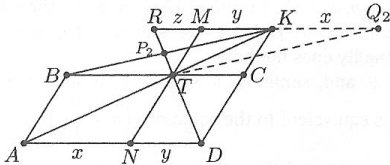
Let P2 be the point of intersection of the segments BK and RD (Fig. 2). Construct a line passing through T parallel to BK, and let Q2 be the point of intersection of this line with the line MK. By Thales' theorem,
RP2:P2T=RK:KQ2=[BKQ2T,BTNA,NMKD is a parallelogram,]
KQ2=BT=AN=x,MK=ND=y]=(z+y):x=(k2+k).
Therefore,
RP2=(k2+k)P2T=k(k+1)(RT−RP2)⟹
RP2=k2+k+1k(k+1)RT=[RT=kTD=k(RD−RT)⟹
RT=k+1kRD]=k2+k+1k2RD.
Comparing this result with (2), we see that P1 coincides with P2, and so they coincide with P, which gives the required statement.