Maths Olympiad Prep

Library / /6 of 24

Geometry Difficulty 5.8 AIME, harder Prove it Netherlands

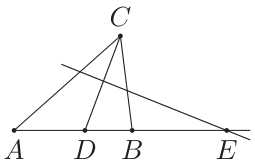
In triangle ABCABC, the point DD lies on segment ABAB such that CDCD is the angle bisector of angle CC. The perpendicular bisector of segment CDCD intersects the line ABAB in EE. Suppose that BE=4|BE| = 4 and AB=5|AB| = 5.
Figure 1

a. Prove that BAC=BCE\angle BAC = \angle BCE.

b. Prove that 2AD=ED2|AD| = |ED|.

Solution

a.
In triangle ADC\triangle ADC, the sum of the angles is 180180^\circ, hence
BAC=DAC=180ADCACD. \angle BAC = \angle DAC = 180^\circ - \angle ADC - \angle ACD.
Because CDCD is the angle bisector of ACB\angle ACB, we have ACD=DCB\angle ACD = \angle DCB and hence the equality above can be rewritten as
BAC=180ADCDCB. \angle BAC = 180^\circ - \angle ADC - \angle DCB.
Now we use that ADB\angle ADB is a straight angle, hence EDC=180ADC\angle EDC = 180^\circ - \angle ADC. Substituting this yields
BAC=EDCDCB. \angle BAC = \angle EDC - \angle DCB.
Because EE lies on the perpendicular bisector of CDCD, we have EDC=ECD\angle EDC = \angle ECD, and the equality becomes
BAC=ECDDCB. \angle BAC = \angle ECD - \angle DCB.
Finally, we also see in the picture that ECDDCB=BCE\angle ECD - \angle DCB = \angle BCE, and hence
BAC=BCE. \angle BAC = \angle BCE. \quad \square

b.
Triangles ACE\triangle ACE and CBE\triangle CBE are similar, because AEC=CEB\angle AEC = \angle CEB (same angle) and in part (a) we proved that BAC=BCE\angle BAC = \angle BCE and hence CAE=BCE\angle CAE = \angle BCE. This yields
AECE=CEBE. \frac{|AE|}{|CE|} = \frac{|CE|}{|BE|}.
Using the fact that BE=4|BE| = 4, we compute
AE=AB+BE=5+4=9. |AE| = |AB| + |BE| = 5 + 4 = 9.
Substituting this in the ratios above, we obtain
9CE=CE4, \frac{9}{|CE|} = \frac{|CE|}{4},
hence CE2=36|CE|^2 = 36 and CE=6|CE| = 6. Because the perpendicular bisector of CDCD passes through EE, we have CE=DE|CE| = |DE|. This yields
6=CE=DE=DB+BE=DB+4 6 = |CE| = |DE| = |DB| + |BE| = |DB| + 4
and hence DB=2|DB| = 2. Therefore, we conclude that
AD=ABBD=52=3andED=6. |AD| = |AB| - |BD| = 5 - 2 = 3 \quad \text{and} \quad |ED| = 6.
We obtain that 2AD=23=6=ED2|AD| = 2 \cdot 3 = 6 = |ED|. \square

Want a route through all this instead of an archive? The track puts 2,000 problems in a working order, from AMC 10 level to the IMO shortlist.

Source: MathNet, licensed CC-BY-4.0. Statement and solution reproduced as published; topic and difficulty added by this site.