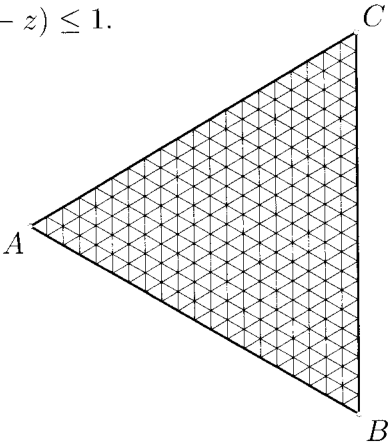
Let △ABC be an equilateral triangle with the side of 20 units. Vid divides this triangle into 400 smaller equilateral triangles with the sides of 1 unit. Eva then picks 4 of the vertices of these smaller triangles. The vertices lie inside the triangle ABC and form a parallelogram with sides parallel to the sides of the triangle ABC. There are exactly 46 smaller triangles that have at least one point in common with the sides of this parallelogram. Find all possible values for the area of this parallelogram.
Solution
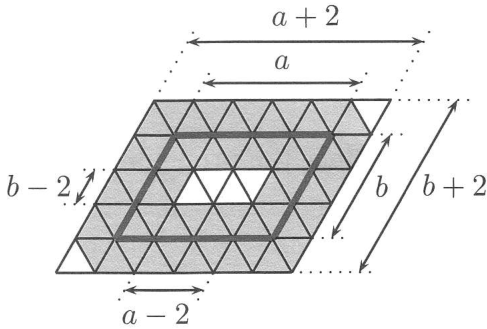
Denote the sides of the parallelogram by a and b. We may assume that a≥b. The small triangles which share at least one point with the sides of the parallelogram are marked in the figure. We can find their number by subtracting 2 triangles in the corners and the number of the triangles inside the white parallelogram from the number of all triangles in the enlarged parallelogram.
When b≤2 there is no white parallelogram. If b=1, then the number of the small triangles is equal to the number of the triangles inside a parallelogram of size (a+2)×3, minus 2. There are 2⋅3(a+2) of the triangles in the parallelogram, so 6(a+2)−2=46. This implies a=6.
If b=2, then there are 2⋅(a+2)⋅4−2=46 small triangles and this implies a=8.
Let b≥3. The enlarged parallelogram contains 2(a+2)(b+2) small triangles and the white parallelogram contains 2(a−2)(b−2) small triangles. We get 2(a+2)(b+2)−2(a−2)(b−2)−2=46, and this implies a+b=6. Since a≥b≥3, this is only possible when a=b=3.
Let us find the areas of these parallelograms. Since the acute angle in these parallelograms measures 60∘, the areas are equal to 23ab.
When a=6, b=1 we get 33.
When a=b=3 we get 293.
When a=4, b=2 we get 43.
Want a route through all this instead of an archive? The track
puts 2,604 problems in a working order, from Junior Challenge level to the IMO shortlist.
Source: MathNet,
licensed CC-BY-4.0.
Statement reproduced verbatim; metadata (topic, difficulty) added by this project.