Let be a permutation of the vertices of a regular -gon. Prove that every closed polygonal line that consists of segments
contains at least one pair of parallel segments.
Hrvatska, 2011
Solution
Assign numbers to the vertices of the observed -gon respectively. Let be the number assigned to the vertex . Then is a permutation of .
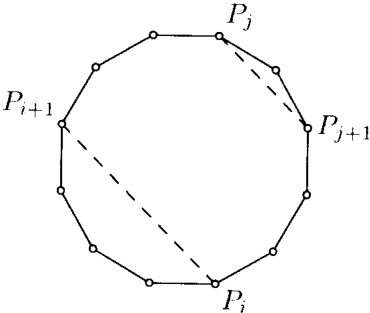
Segments and for are parallel if and only if they determine an isosceles trapezoid with bases and . Its legs (or diagonals) and are congruent and a rotation around the circumcenter maps points and into points if are mapped respectively.
That is why the condition is equivalent to the condition that the number of vertices between and is equal to the number of vertices between and , taking into account the orientation. That condition can be written as , i.e.
Now assume that none of the given segments are parallel.
Then the sums give different remainders modulo , so
The sum on the right hand side is which is congruent to modulo .
On the other hand, we have
The resulting expression is divisible by , which is in contradiction with the conclusion above. Therefore our assumption was incorrect which means there is at least one pair of parallel segments.
Want a route through all this instead of an archive? The track
puts 2,604 problems in a working order, from Junior Challenge level to the IMO shortlist.