Maths Olympiad Prep

Library / /10 of 15

Geometry Difficulty 8.2 Shortlist Prove it Romania

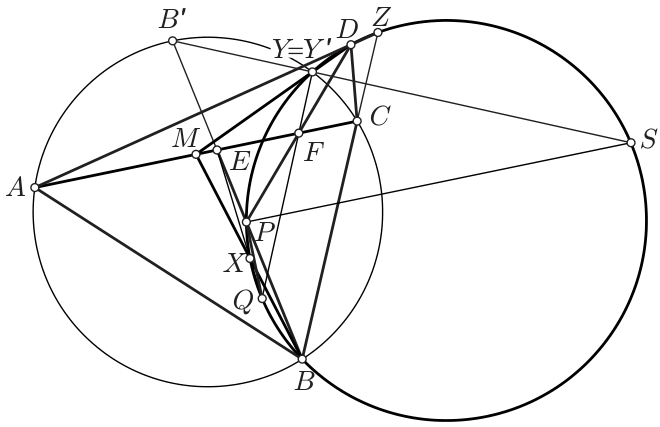
Let ABCDABCD be a convex quadrangle such that ABC=ADC<90\angle ABC = \angle ADC < 90^\circ. The internal bisectrices of the angles ABCABC and ADCADC cross the diagonal ACAC at EE and FF, respectively, and meet at PP. Let MM be the midpoint of the diagonal ACAC. The segments BMBM and DMDM cross the circle BDPBDP again at XX and YY, respectively, and the lines EXEX and FYFY meet at QQ. Prove that the lines ACAC and PQPQ are perpendicular.

IMO 2016 Shortlist

Solutions — 3

Solution 1

We first show that YY lies on the circle ABCABC. To this end, let YY' be the point on the ray MDMD, emanating from MM, such that MYMD=MA2MY' \cdot MD = MA^2. The triangles MAYMAY' and MDAMDA are therefore similar and have opposite orientations. Since MYMD=MA2=MC2MY' \cdot MD = MA^2 = MC^2, so are the triangles MCYMCY' and MDCMDC. Hence, using directed angles, AYC=AYM+MYC=MAD+DCM=CDA=ABC\angle AY'C = \angle AY'M + \angle MY'C = \angle MAD + \angle DCM = \angle CDA = \angle ABC, so YY' lies on the circle ABCABC.

Let the lines ADAD and BCBC meet at ZZ. The equality of directed angles PDZ=PBC=PBZ\angle PDZ = \angle PBC = \angle PBZ shows that ZZ lies on the circle BDPBDP; and the equality of directed angles YBZ=YBC=YAC=YAM=YDZ\angle Y'BZ = \angle Y'BC = \angle Y'AC = \angle Y'AM = \angle Y'DZ shows that so does YY'. Since the angle ADCADC is acute, MAMDMA \neq MD, so MYMDMY' \neq MD, and YY' is therefore the point where MDMD crosses the circle BDPBDP again. Consequently, Y=YY' = Y, so the latter lies on the circle ABCABC, by the preceding paragraph.

Figure 1

Next, we show that FYFY is the internal bisectrix of the angle AYCAYC. To this end, simply refer to the internal angle bisectrix theorem and the similar triangles above, to write
FAFC=ADCD=ADAMCMCD=YAYMYMYC=YAYC. \frac{FA}{FC} = \frac{AD}{CD} = \frac{AD}{AM} \cdot \frac{CM}{CD} = \frac{YA}{YM} \cdot \frac{YM}{YC} = \frac{YA}{YC}.
Let now BEBE, the internal bisectrix of the angle ABCABC, cross the circle ABCABC again at BB', so the latter is the midpoint of the arc ACAC not containing BB. The line BYB'Y is therefore the external bisectrix of the angle AYCAYC, so it is perpendicular to FYFY, by the preceding paragraph.

Let the line \ell through PP and parallel to ACAC meet the line BYB'Y at SS. To prove the required perpendicularity, we show PQPQ and PSPS perpendicular.

Use directed angles to write PSY=(AC,BY)=ACY+CYB=ACY+CAB=ACY+BCA=BCY=BBY=PBY\angle PSY = \angle(AC, B'Y) = \angle ACY + \angle CYB' = \angle ACY + \angle CAB' = \angle ACY + \angle B'CA = \angle B'CY = \angle B'BY = \angle PBY, and infer that SS lies on the circle BDPBDP. Restated, the line through YY and perpendicular to FYFY passes through the point where \ell crosses the circle BDPBDP again, which is SS. Similarly, the line through XX and perpendicular to EXEX passes through the point where \ell crosses the circle BDPBDP again, which is SS. Consequently, QXQX and QYQY are perpendicular to SXSX and SYSY, respectively, so QQ lies on the circle BDPBDP of which QSQS is a diameter. The conclusion follows.

Solution 2

Begin by noticing that, since ABC=ADC\angle ABC = \angle ADC, the circles ABCABC and ACDACD are reflections of one another across MM.

We first show that XX lies on the circle ACDACD. To this end, let the ray MBMB, emanating from MM, cross the circle ACDACD at X1X_1, and let XX' be the reflection of X1X_1 across MM. By the preceding, XX' lies on the circle ABCABC and AX1CXAX_1CX' is a parallelogram, so, using directed angles, DX1B=DX1A+AX1B=DCA+AX1X=DCA+CXX1=DCA+CXB=DCA+CAB=(CD,AB)\angle DX_1B = \angle DX_1A + \angle AX_1B = \angle DCA + \angle AX_1X' = \angle DCA + \angle CX'X_1 = \angle DCA + \angle CX'B = \angle DCA + \angle CAB = \angle(CD, AB). The equality of directed angles DPB=PDC+(CD,AB)+ABP=(CD,AB)\angle DPB = \angle PDC + \angle(CD, AB) + \angle ABP = \angle(CD, AB) therefore implies that DX1B=DPB\angle DX_1B = \angle DPB, so X1X_1 lies on the circle BDPBDP. It follows that X1X_1 and XX coincide, so XX lies on the circle ACDACD. Similarly, YY lies on the circle ABCABC.

Next, we show that QQ lies on the circle BDPBDP. To this end, let the perpendicular bisectrix of the segment ACAC cross the circle ABCABC at BB' and M1M_1, and the circle ACDACD at DD' and M2M_2, so that B,DB, D' and M1M_1 all lie in the same half-plane relative to the line ACAC. Notice that BB' and DD' lie on the bisectrices BPBP and DPDP, respectively, of the angles ABCABC and ADCADC, respectively. Further, notice that
BAXABCXC=area BAXarea BCX=MAMC=1, \frac{BA \cdot X'A}{BC \cdot X'C} = \frac{\text{area } BAX'}{\text{area } BCX'} = \frac{MA}{MC} = 1,
and refer to the fact that BEBE bisects the angle ABCABC, to write
EAEC=BABC=XCXA=XAXC, \frac{EA}{EC} = \frac{BA}{BC} = \frac{X'C}{X'A} = \frac{XA}{XC},
and infer that XEXE bisects the angle AXCAXC, so M2M_2 lies on the line through E,Q,XE, Q, X.

Similarly, M1M_1 lies on the line through F,Q,YF, Q, Y. Use directed angles to write XQY=M2QM1=QM2M1+M2M1Q=XM2D+BM1Y=XDD+BBY=XDP+PBY=XBP+PBY=XBY\angle XQY = \angle M_2QM_1 = \angle QM_2M_1 + \angle M_2M_1Q = \angle XM_2D' + \angle B'M_1Y = \angle XDD' + \angle B'BY = \angle XDP + \angle PBY = \angle XBP + \angle PBY = \angle XBY, and infer that QQ lies on the circle BDPBDP.

Finally, since M1M_1 and M2M_2 are reflections of one another across MM, the quadrangle XM1XM2XM_1X'M_2 is a parallelogram, so, using directed angles, XQP=XBP=XBB=XM1B=XM2M1\angle XQP = \angle XBP = \angle X'BB' = \angle X'M_1B' = \angle XM_2M_1. This shows that PQPQ and M1M2M_1M_2 are parallel; since the latter is perpendicular to ACAC, so is the former.

Solution 3

If one of the vertices BB, DD lies on the perpendicular bisectrix of the diagonal ACAC, so do both PP and QQ, and the conclusion follows.

Assuming now that neither BB nor DD lie on the perpendicular bisectrix of the diagonal ACAC, we show that PP and QQ project orthogonally to the same point on the line ACAC. To this end, project PP and QQ on the line ACAC to PP' and QQ', respectively, and notice that the two coincide if and only if, in terms of directed segments, EP/FP=EQ/FQEP'/FP' = EQ'/FQ'. Notice that
EPFP=tanEFPtanFEP=tanAFDtanAEBandEQFQ=tanEFQtanFEQ, \frac{EP'}{FP'} = \frac{\tan \angle EFP}{\tan \angle FEP} = \frac{\tan \angle AFD}{\tan \angle AEB} \quad \text{and} \quad \frac{EQ'}{FQ'} = \frac{\tan \angle EFQ}{\tan \angle FEQ},
where angles are all directed, so it is sufficient to show that
(tanAEB)(tanEFQ)=(tanAFD)(tanFEQ). (\tan \angle AEB)(\tan \angle EFQ) = (\tan \angle AFD)(\tan \angle FEQ).
To this end, let the line through BB and perpendicular to BEBE meet the line ACAC at TT. We will prove that B,E,T,XB, E, T, X are concyclic, so, in terms of directed angles, FEQ=TEX=π/2+EBM\angle FEQ = \angle TEX = \pi/2 + \angle EBM. Similarly, EFQ=π/2+FDM\angle EFQ = \pi/2 + \angle FDM, so it is sufficient to show that
(tanAEB)(tanMBE)=(tanAFD)(tanMDF). (\tan \angle AEB)(\tan \angle MBE) = (\tan \angle AFD)(\tan \angle MDF).
With reference to the sine law, straightforward calculations show that the left-hand member is (tanEBA)2(\tan \angle EBA)^2, the right-hand member is (tanFDC)2(\tan \angle FDC)^2, and the conclusion follows by equality of the two angles.

We still have to prove that B,E,T,XB, E, T, X are concyclic. Since BTBT and BXBX are the two bisectrices of the angle ABCABC, the cross-ratio (T,E;A,C)(T, E; A, C) is harmonic, so MEMT=MA2ME \cdot MT = MA^2.

It is therefore sufficient to show that MA2=MBMXMA^2 = MB \cdot MX. To this end, let the lines ABAB and CDCD meet at WW, and let the lines ADAD and BCBC meet at ZZ. Use directed angles to write PDZ=PBC=PBZ\angle PDZ = \angle PBC = \angle PBZ and infer that ZZ lies on the circle BDPBDP; similarly, so does WW, and the quadrangle BDWZBDWZ is therefore cyclic.

Reflect CC in the circle BDWZBDWZ, centered at OO, to obtain CC'. Since AA lies on the polar of CC with respect to this circle, the lines ACAC' and OCOC are perpendicular, so CC' lies on the circle γ\gamma on diameter ACAC. It follows that reflection in the circle BDWZBDWZ sends γ\gamma to itself, so the two circles are orthogonal. Consequently, the power of MM with respect to the circle BDWZBDWZ is the square of the radius of γ\gamma; that is, MBMX=MA2MB \cdot MX = MA^2. This completes the proof.

Want a route through all this instead of an archive? The track puts 2,000 problems in a working order, from AMC 10 level to the IMO shortlist.

Source: MathNet, licensed CC-BY-4.0. Statement and solution reproduced as published; topic and difficulty added by this site.