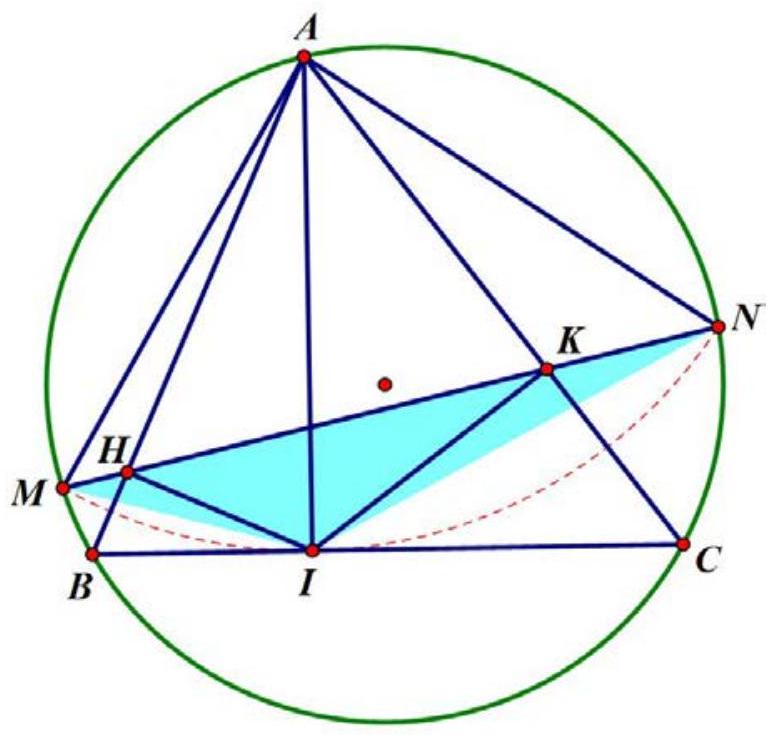
1) We will use the inversion to solve this problem.
Note that △AHI∼△AIB and that △AKI∼△AIC, hence
AI2=AH⋅AB=AK⋅AC=:k.
Let f be the inversion with center A and power k. Then
f(I)=I, f(H)=B, f(B)=H, f(K)=C, f(C)=K.
So this inversion sends the line HK to (O), which implies that the intersection of HK and (O) are fixed points under f.
Therefore, AM2=AN2=k=AI2; therefore, A is the center of the circle (IMN).
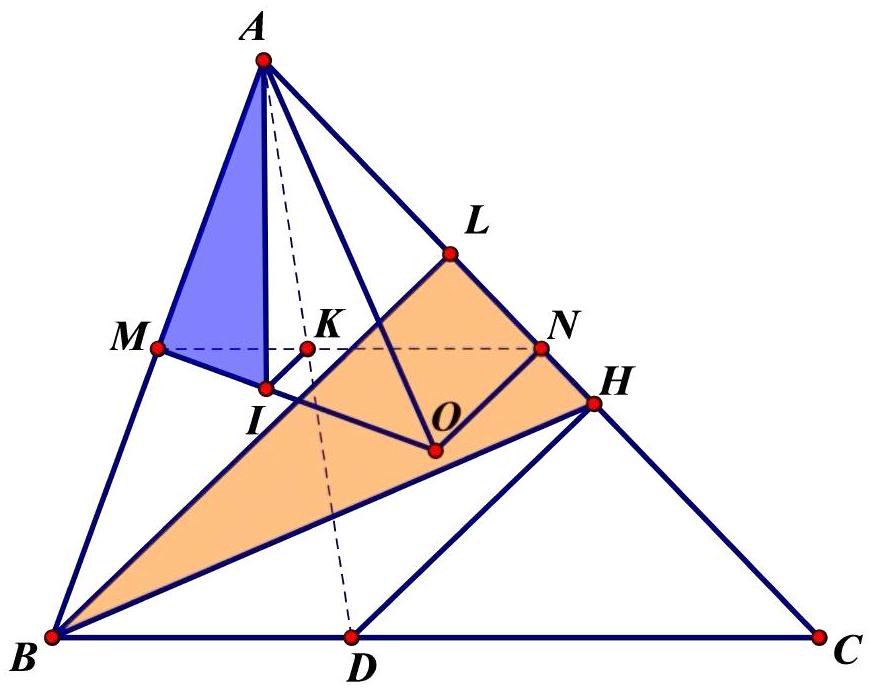
2) First, we will prove the following lemma: Let D be a point on the segment BC and H be the projection of D on AC. Suppose that I is the circumcenter of triangle ABH. Denote by M,N the midpoints of AB,AC respectively. Let MN meet AD at K. Then IK⊥AC.
Denote by L the projection of B on AC. It is easy to see that I,M,O are collinear. Further,
∠AIM=∠LHB, ∠AOM=∠LCB,
hence △AIM∼△BHL and △AOM∼△CBL.
It follows that
IOIM=LCLH=BCBD=MNMK;
which implies that IK∥ON, i.e. IK⊥AC.
Going back to the original problem, we denote by B′,C′ the midpoints of AB,AC and by Z the intersection of B′C′ and AI.
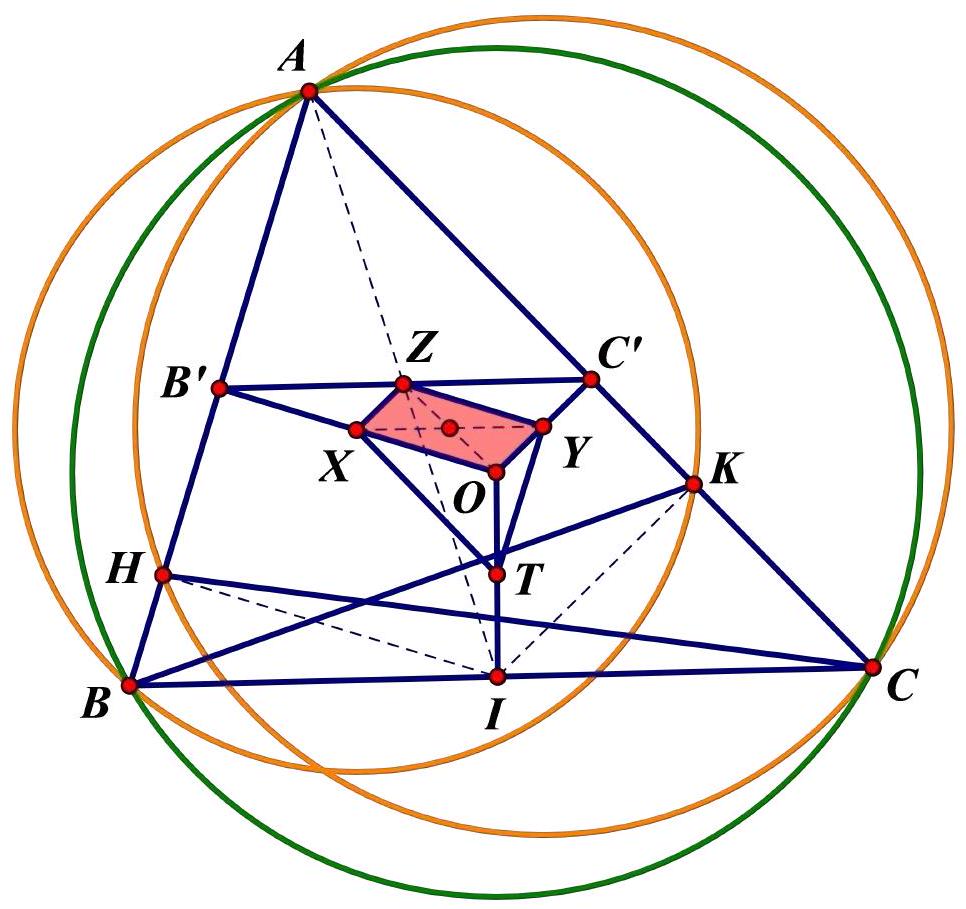
Applying the lemma, we have XZ∥OC′ and YZ∥OB′; therefore, OXZY is a parallelogram.
Hence, OZ passes through the midpoint of XY. But XY∥B′C′, so Z is the midpoint of B′C′ and XY is a medial line of triangle OB′C′.
On the other hand, B′C′∥BC, hence I is the midpoint of BC.
Let T be the midpoint of the segment OI. Then XT∥B′I∥AC. But OC′⊥AC, thus OY⊥XT.
Similarly, OX⊥YT. Therefore, T is the orthocenter of triangle XOY.