Maths Olympiad Prep

Library / /6 of 7

, 2015

Geometry Difficulty 6.3 National olympiad Prove it Romania

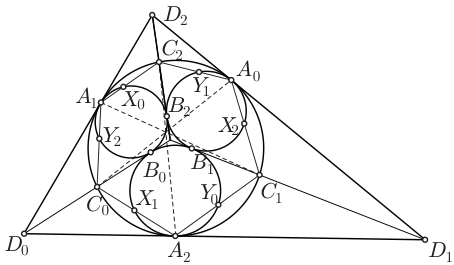
Let γ\gamma, γ0\gamma_0, γ1\gamma_1, γ2\gamma_2 be coplanar circles such that γi\gamma_i is internally tangent to γ\gamma at AiA_i, and γi\gamma_i and γi+1\gamma_{i+1} are externally tangent at Bi+2B_{i+2}, i=0,1,2i = 0, 1, 2 (indices are reduced modulo 33). The tangent at BiB_i, common to γi1\gamma_{i-1} and γi+1\gamma_{i+1}, meets γ\gamma at CiC_i, located in the half-plane opposite AiA_i with respect to the line Ai1Ai+1A_{i-1}A_{i+1}. Show that the three lines AiCiA_iC_i are concurrent.
Flavian Georgescu

Solution

Let γi\gamma_i cross the lines AiCi+1A_iC_{i+1} and AiCi+2A_iC_{i+2} again at Xi+2X_{i+2} and Yi+1Y_{i+1}, respectively.

Since the homothety centred at AiA_i, transforming γi\gamma_i into γ\gamma, sends Xi+2X_{i+2} to Ci+1C_{i+1} and Yi+1Y_{i+1} to Ci+2C_{i+2}, the lines Xi+2Yi+1X_{i+2}Y_{i+1} and Ci+1Ci+2C_{i+1}C_{i+2} are parallel, so AiCi+1/AiCi+2=Xi+2Ci+1/Yi+1Ci+2A_iC_{i+1}/A_iC_{i+2} = X_{i+2}C_{i+1}/Y_{i+1}C_{i+2}.

On the other hand, since CiC_i has equal powers relative to γi+1\gamma_{i+1} and γi+2\gamma_{i+2}, CiXi+1CiAi+2=CiBi2=CiYi+2CiAi+1C_iX_{i+1} \cdot C_iA_{i+2} = C_iB_i^2 = C_iY_{i+2} \cdot C_iA_{i+1}, it follows that CiXi+1=CiBi2/CiAi+2C_iX_{i+1} = C_iB_i^2/C_iA_{i+2} and CiYi+2=CiBi2/CiAi+1C_iY_{i+2} = C_iB_i^2/C_iA_{i+1}.

Hence AiCi+1/AiCi+2=(Bi+1Ci+1/Bi+2Ci+2)2(AiCi+2/AiCi+1)A_iC_{i+1}/A_iC_{i+2} = (B_{i+1}C_{i+1}/B_{i+2}C_{i+2})^2(A_iC_{i+2}/A_iC_{i+1}), so AiCi+1/AiCi+2=Bi+1Ci+1/Bi+2Ci+2A_iC_{i+1}/A_iC_{i+2} = B_{i+1}C_{i+1}/B_{i+2}C_{i+2}, and consequently i=02(AiCi+1/AiCi+2)=i=02(Bi+1Ci+1/Bi+2Ci+2)=1\prod_{i=0}^2 (A_iC_{i+1}/A_iC_{i+2}) = \prod_{i=0}^2 (B_{i+1}C_{i+1}/B_{i+2}C_{i+2}) = 1. Since the sines of the angles CiAiCjC_iA_iC_j are proportional to the lengths of the corresponding chords AiCjA_iC_j, the conclusion follows by Ceva's theorem in trigonometric form in the triangle C0C1C2C_0C_1C_2.

Figure 1

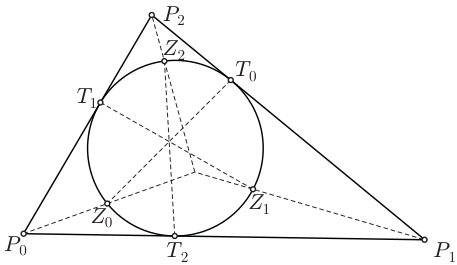
Figure 2

Alternative Solution:
Let the tangents to γ\gamma at AiA_i and Ai+1A_{i+1} meet at Di+2D_{i+2} (fig 1), and notice that the latter has equal powers relative to γi\gamma_i and γi+1\gamma_{i+1} to deduce that it lies on their radical axis, Bi+2Ci+2B_{i+2}C_{i+2}. Consequently, the lines CiDiC_iD_i are concurrent at the radical center of the γi\gamma_i, and the conclusion follows by the lemma below (see Figure 2).

Lemma. Let P0P1P2P_0P_1P_2 be a triangle, and let TiT_i be the touchpoint of the side Pi+1Pi+2P_{i+1}P_{i+2} and the incircle γ\gamma of the triangle P0P1P2P_0P_1P_2. Let further ZiZ_i be a point on the arc Ti+1Ti+2T_{i+1}T_{i+2} of γ\gamma not containing TiT_i. Then the lines TiZiT_iZ_i are concurrent if and only if the lines PiZiP_iZ_i are concurrent.

Want a route through all this instead of an archive? The track puts 2,000 problems in a working order, from AMC 10 level to the IMO shortlist.

Source: MathNet, licensed CC-BY-4.0. Statement and solution reproduced as published; topic and difficulty added by this site.