Consider hexagons whose internal angles are all equal.
(i) Prove that for any such hexagon the sum of the lengths of any two neighbouring sides is equal to the sum of the lengths of their opposite sides.
(ii) Does there exist such a hexagon with side lengths 1, 2, 3, 4, 5 and 6 in some order?
Final Round of National Olympiad
Solutions — 3
Solution 1
(i) Let the hexagon be . It suffices to show that .
Let be the intersection point of rays and and let be the intersection point of rays and (Fig. 8). The size of every internal angle of the hexagon is , whence triangles and are equilateral. The quadrilateral is a parallelogram since its opposite sides are parallel. This implies or , which together with and implies the desired equality .
(ii) Take a parallelogram with side lengths 7 and 5 and internal angles and , and cut off equilateral triangles with side lengths 1 and 2 at its acute angles. This gives rise to a hexagon with all internal angles having size and side lengths 1, 4, 5, 2, 3, 6 (Fig. 9).
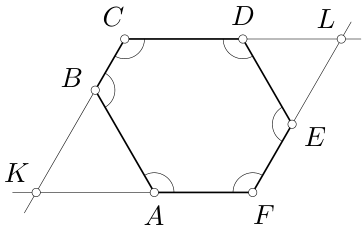
Figure 8
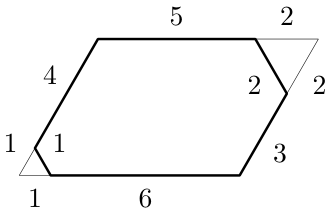
Figure 9
Solution 2
(i) Note that the external angles of the hexagon have size . Any two opposite sides of the hexagon are parallel, as they are separated by exactly three external angles.
Consider a line perpendicular to opposite sides and of the hexagon (Fig. 10). As all other sides form the same angle with line , the lengths of these sides are proportional to the lengths of the projections of the sides to line . The sum of the lengths of the projections of sides and is equal to the distance between the parallel lines and and the same holds also for the opposite sides and . Therefore the sum of the lengths of the projections of sides and is equal to that of sides and , whence the sums of the lengths of the sides are equal as well.
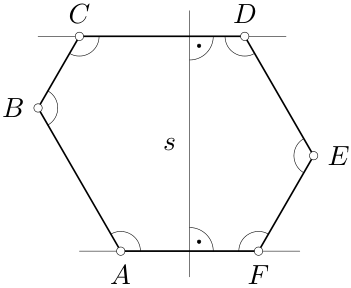
Figure 10
(ii) Figure 11 shows a hexagon in a triangular grid with distance between neighbouring nodes being 1. The side lengths of the hexagon are 1, 4, 5, 2, 3 and 6.
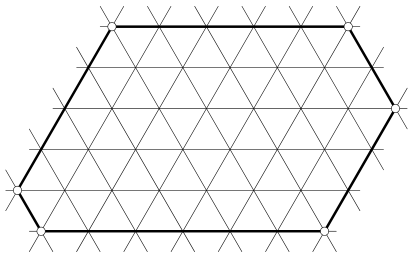
Figure 11
Solution 3
Consider two types of transformations on hexagons that maintain the property that all internal angles are of the same size.
(1) Prolonging two opposite sides by the same quantity (Fig. 12); this causes the side lengths to change according to the template
(2) Prolonging the two neighbouring sides of one particular side by the same quantity (Fig. 13); this causes the side lengths to change according to the template
A straightforward check shows that both transformations maintain the desired property, no matter of in which direction the transformations are applied.
(i) As the internal angles of all regular hexagons are equal, it suffices to show that an arbitrary hexagon with all internal angles equal can be turned into a regular hexagon by a finite sequence of the transformations above.
Indeed, let the side lengths of a given hexagon with all internal angles equal be . Assume w.l.o.g. that and . Choose a quantity such that ; by applying the transformation (1) thrice, we can obtain a hexagon with three consecutive sides having the same length:
By the assumption made above we have and . W.l.o.g., assume also . The transformation
leads to a hexagon with four consecutive sides of equal length. But this must be regular since all of its internal angles are equal (Fig. 14).
(ii) Such a hexagon can be obtained from a regular hexagon with side length 1 by the following transformations:
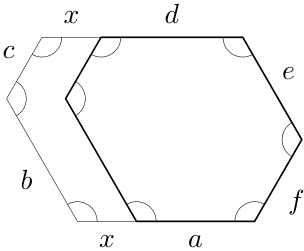
Figure 12
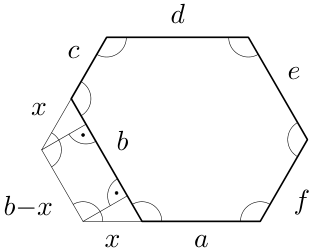
Figure 13
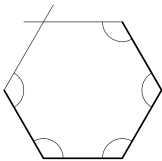
Figure 14
Want a route through all this instead of an archive? The track
puts 2,604 problems in a working order, from Junior Challenge level to the IMO shortlist.