We have ∠ADE=∠B and ∠ADF=∠C. So AFDE is a cyclic
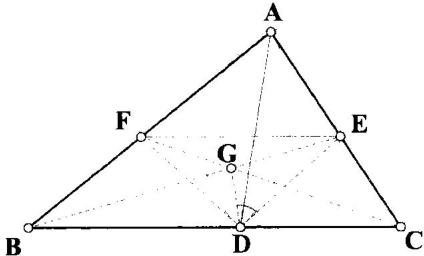
quadrilateral and
∠AFE=∠ADE=∠B and ∠AEF=∠ADF=∠C,
Hence, EF is parallel to BC and DE=DF, so the triangle FDE is isosceles.
Let M be the midpoint of EF, L=AD∩EF, and H=DG∩EF. By Thales Theorem, we obtain
LFLE=BDDC
Also, from △FGH∼△CGD it follows that
DCHF=GDGH
From △EGH∼△BGD, we get
BDHE=GDGH
and from this
HEHF=DBDC
then H and L are symmetric with center M, as we will see later and ∠LDM=∠HDM=α with
α=90∘−∠ADC=2∠C−∠B if C>B,
and
α=90∘−∠ADB=2∠B−∠C if B>C.
Finally,
∠GDE=∠ADE−α=∠ADF if B>C,
and
∠GDE=∠ADE+α=∠ADF if B<C.
It remains to prove that L and H are symmetric with center M. To do so denote
LF+LE=HF+HE=s, and then
LFLE=HEHF
hence
LFs=HEs⇒LF=HE and LE=HF
that is, HM=ML, as we wanted to prove.