Maths Olympiad Prep

Library / /3 of 10

Algebra Difficulty 8.4 Shortlist Prove it China

Prove that the real-coefficient polynomial in x,y,zx, y, z,
x4(xy)(xz)+y4(yz)(yx)+z4(zx)(zy), x^{4}(x - y)(x - z) + y^{4}(y - z)(y - x) + z^{4}(z - x)(z - y),
cannot be expressed as a finite sum of squares of real-coefficient polynomials in x,y,zx, y, z.

Solutions — 2

Solution 1

Denote the given polynomial by F(x,y,z)F(x, y, z). By contradiction, assume there exist real-coefficient polynomials f1(x,y,z)f_1(x, y, z), f2(x,y,z)f_2(x, y, z), ..., fm(x,y,z)f_m(x, y, z) satisfying
F(x,y,z)=i=1mfi(x,y,z)2.(1) F(x, y, z) = \sum_{i=1}^{m} f_i(x, y, z)^2. \qquad (1)
First, all fif_i must have degree at most 3. If some fif_i had degree d>3d > 3, then the sum of squares of their degree dd homogeneous parts would be 0, implying all these parts vanish, which is a contradiction!
Thus all deg(fi)3\deg(f_i) \le 3. By replacing each fi(x,y,z)f_i(x, y, z) with its degree 3 homogeneous part, we may assume each fi(x,y,z)f_i(x, y, z) is a homogeneous real-coefficient polynomial of degree 3.
Setting x=yx = y in (1) yields
z4(zy)2=i=1mfi(y,y,z)2.(2) z^4(z-y)^2 = \sum_{i=1}^{m} f_i(y, y, z)^2. \qquad (2)
Let gi(y,z)=fi(y,y,z)g_i(y, z) = f_i(y, y, z). Setting y=zy = z in (2) gives 0=i=1mgi(y,y)20 = \sum_{i=1}^{m} g_i(y, y)^2, so gi(y,y)=0g_i(y, y) = 0 for all ii. Thus zygi(y,z)z - y \mid g_i(y, z); similarly, setting z=0z = 0 shows zgi(y,z)z \mid g_i(y, z). Therefore we can write gi(y,z)=z(zy)hi(y,z)g_i(y, z) = z(z - y)h_i(y, z), where hi(y,z)h_i(y, z) is linear in yy and zz. Substituting into (2) and canceling z2(zy)2z^2(z - y)^2 gives
z2=i=1mhi(y,z)2. z^2 = \sum_{i=1}^{m} h_i(y, z)^2.
Setting z=0z = 0 shows hi(y,z)=αizh_i(y, z) = \alpha_i z, so fi(y,y,z)=αiz2(zy)f_i(y, y, z) = \alpha_i z^2(z - y), where αiR\alpha_i \in \mathbb{R}. In particular, the coefficients of y3y^3 and y2zy^2z in fi(y,y,z)f_i(y, y, z) are 0, and the sum of coefficients of z3z^3 and z2yz^2y is 0.
Now fix one fif_i and write fi=u,v,w0u+v+w=3au,v,wxuyvzwf_i = \sum_{\substack{u,v,w \ge 0 \\ u+v+w=3}} a_{u,v,w} x^u y^v z^w. Then:
{a3,0,0+a2,1,0+a1,2,0+a0,3,0=0;a2,0,1+a1,1,1+a0,2,1=0;a1,0,2+a0,1,2+a0,0,3=0.(3) \left\{ \begin{array}{l} a_{3,0,0} + a_{2,1,0} + a_{1,2,0} + a_{0,3,0} = 0; \\ a_{2,0,1} + a_{1,1,1} + a_{0,2,1} = 0; \\ a_{1,0,2} + a_{0,1,2} + a_{0,0,3} = 0. \end{array} \right. \qquad (3)
These relations can be visualized in Figure 1, where dashed boxes enclose elements summing to 0.
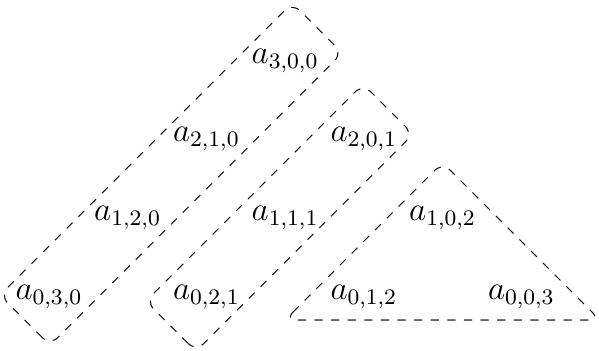
Figure 1
Figure 1

By symmetry, we also have:
{a3,0,0+a2,0,1+a1,0,2+a0,0,3=0;a0,3,0+a0,2,1+a0,1,2+a0,0,3=0;a1,2,0+a1,1,1+a1,0,2=0;a2,1,0+a1,1,1+a0,1,2=0.(4) \left\{ \begin{array}{l} a_{3,0,0} + a_{2,0,1} + a_{1,0,2} + a_{0,0,3} = 0; \\ a_{0,3,0} + a_{0,2,1} + a_{0,1,2} + a_{0,0,3} = 0; \\ a_{1,2,0} + a_{1,1,1} + a_{1,0,2} = 0; \\ a_{2,1,0} + a_{1,1,1} + a_{0,1,2} = 0. \end{array} \right. \qquad (4)
In the figure, this corresponds to sums of elements along edges and diagonals being 0.
From (3), the sum of all au,v,wa_{u,v,w} is 0. Removing the corner triangles shows a1,1,1=0a_{1,1,1} = 0.
Then (4) implies:
a2,1,0+a0,1,2=0,a2,0,1+a0,2,1=0,a1,2,0+a1,0,2=0. a_{2,1,0} + a_{0,1,2} = 0, \quad a_{2,0,1} + a_{0,2,1} = 0, \quad a_{1,2,0} + a_{1,0,2} = 0.
Let a=a2,1,0a = a_{2,1,0}, b=a0,2,1b = a_{0,2,1}, c=a1,0,2c = a_{1,0,2}, then a0,1,2=aa_{0,1,2} = -a, a2,0,1=ba_{2,0,1} = -b, a1,2,0=ca_{1,2,0} = -c.
Now, the coefficient of x2y2z2x^2y^2z^2 in fi(x,y,z)2f_i(x, y, z)^2 is:
a1,1,12+2a2,1,0a0,1,2+2a2,0,1a0,2,1+2a1,2,0a1,0,2=2a22b22c20, a_{1,1,1}^2 + 2a_{2,1,0} \cdot a_{0,1,2} + 2a_{2,0,1} \cdot a_{0,2,1} + 2a_{1,2,0} \cdot a_{1,0,2} = -2a^2 - 2b^2 - 2c^2 \le 0,
while F(x,y,z)F(x, y, z) has coefficient 0 for x2y2z2x^2y^2z^2. From (1), we must have a=b=c=0a = b = c = 0 for
each fif_i. Substituting back into (3) and (4) shows fi=0f_i = 0, contradicting (1). Therefore,
F(x,y,z)F(x, y, z) cannot be expressed as a finite sum of squares. \square

Solution 2

Denote the polynomial by F(x,y,z)F(x, y, z). By contradiction, assume FF can be written as a sum of squares of real-coefficient polynomials. Then there exist fi(x,y,z),gi(x,y,z)R[x,y,z]f_i(x, y, z), g_i(x, y, z) \in \mathbb{R}[x, y, z] (i=1,,mi = 1, \dots, m) with:
F=i=1m(xfi+gi)2=i=1mx2fi2+i=1mgi2+2xi=1mfigi,(5) F = \sum_{i=1}^{m} (x f_i + g_i)^2 = \sum_{i=1}^{m} x^2 f_i^2 + \sum_{i=1}^{m} g_i^2 + 2x \sum_{i=1}^{m} f_i g_i, \quad (5)
where each monomial in fi(x,y,z)f_i(x, y, z), gi(x,y,z)g_i(x, y, z) has even degree in xx. Since deg(F)=6\deg(F) = 6, as
in Proof 1 we may assume fi,gif_i, g_i are homogeneous of degrees 2 and 3 respectively, with
degxfi2\deg_x f_i \le 2, degxgi2\deg_x g_i \le 2.

Setting (x,y,z)=(0,1,1)(x, y, z) = (0, 1, 1) in (5) gives:
i=1mgi2(0,1,1)=0, \sum_{i=1}^{m} g_{i}^{2}(0, 1, 1) = 0,
so gi(0,1,1)=0g_i(0, 1, 1) = 0. Thus we can write gi=cix2+(yz)dig_i = c_i x^2 + (y-z)d_i for some ci,diR[y,z]c_i, d_i \in \mathbb{R}[y, z].
Setting y=z=1y = z = 1 in (5) and comparing coefficients of x2x^2 gives:
i=1mfi2(0,1,1)=0, \sum_{i=1}^{m} f_{i}^{2}(0, 1, 1) = 0,
so fi(0,1,1)=0f_i(0, 1, 1) = 0. Thus fi=aix2+(yz)bif_i = a_i x^2 + (y-z)b_i for some biR[y,z]b_i \in \mathbb{R}[y, z] and aiRa_i \in \mathbb{R}.
Using the identity:
(ax3+b)2+(cx3+d)2=(a2+c2x3+ab+cda2+c2)2+(adbca2+c2)2, (ax^3 + b)^2 + (cx^3 + d)^2 = \left(\sqrt{a^2 + c^2}x^3 + \frac{ab + cd}{\sqrt{a^2 + c^2}}\right)^2 + \left(\frac{ad - bc}{\sqrt{a^2 + c^2}}\right)^2,
we may assume a1=1a_1 = 1 and ai=0a_i = 0 for i2i \ge 2. Comparing coefficients of x5x^5 gives:
2i=1maici=yz, 2 \sum_{i=1}^{m} a_i c_i = -y - z,
so c1=y+z2c_1 = -\frac{y+z}{2}.
Comparing coefficients of x4x^4 gives:
2(yz)b1+i=1mci2=yz. 2(y - z)b_1 + \sum_{i=1}^{m} c_i^2 = yz.
Thus:
2(yz)b1+14(yz)2+i=2mci2=0. 2(y - z)b_1 + \frac{1}{4}(y - z)^2 + \sum_{i=2}^{m} c_i^2 = 0.
Setting y=zy = z shows yzciy - z \mid c_i for i2i \ge 2.

Comparing coefficients of x2x^2 gives:
(yz)i=1mbi2+2i=1mcidi=0. (y - z) \sum_{i=1}^{m} b_i^2 + 2 \sum_{i=1}^{m} c_i d_i = 0.
Setting y=zy = z shows yzd1y - z \mid d_1. Let d1=(yz)(sy+tz)d_1 = (y - z)(sy + tz) for s,tRs, t \in \mathbb{R}.
Comparing coefficients of x3x^3 gives:
d1+i=1mbici=0. d_1 + \sum_{i=1}^{m} b_i c_i = 0.
Setting y=zy = z shows yzb1y - z \mid b_1. Let b1=k(yz)b_1 = k(y - z) for kRk \in \mathbb{R}.
From F(1,1,0)=0F(1, 1, 0) = 0, we get 1+k12+s=01 + k - \frac{1}{2} + s = 0, so s=12ks = -\frac{1}{2} - k. From F(1,0,1)=0F(1, 0, 1) = 0, we get 1+k12+t=01 + k - \frac{1}{2} + t = 0, so t=12kt = -\frac{1}{2} - k.
Thus:
xf1+g1=x(x2+k(yz)2)y+z2x2(12+k)(y+z)(yz)2. x f_1 + g_1 = x(x^2 + k(y - z)^2) - \frac{y+z}{2}x^2 - (\frac{1}{2} + k)(y + z)(y - z)^2.

Setting x=1,y=1x = 1, y = 1 in F(xf1+g1)20F - (xf_1 + g_1)^2 \ge 0 gives:
0z4(z1)2(1z2+k(1z)2(12+k)(1z)2(1+z))2=(z1)2[z4(12+k(1z)(12+k)(1z2))2]. \begin{aligned} 0 &\le z^4(z-1)^2 - \left(\frac{1-z}{2} + k(1-z)^2 - \left(\frac{1}{2} + k\right)(1-z)^2(1+z)\right)^2 \\ &= (z-1)^2 \left[z^4 - \left(\frac{1}{2} + k(1-z) - \left(\frac{1}{2} + k\right)(1-z^2)\right)^2\right]. \end{aligned}
The inequality z2((12+k)zk)20z^2 - ((\frac{1}{2} + k)z - k)^2 \ge 0 holds for all real zz only when k=0k = 0. But then setting z=0,x=7,y=2z = 0, x = 7, y = 2 gives F(x,y,z)(xf1+g1)2=225<0F(x, y, z) - (xf_1 + g_1)^2 = -225 < 0, a contradiction.
Therefore, F(x,y,z)F(x, y, z) cannot be expressed as a finite sum of squares of real-coefficient polynomials. \square

Want a route through all this instead of an archive? The track puts 2,000 problems in a working order, from AMC 10 level to the IMO shortlist.

Source: MathNet, licensed CC-BY-4.0. Statement and solution reproduced as published; topic and difficulty added by this site.