Trapezoid with is given. On diagonals and denote points and respectively, so that bisects , bisects . Prove that .
Ukrainian National Mathematical Olympiad - Fourth Round
Solution
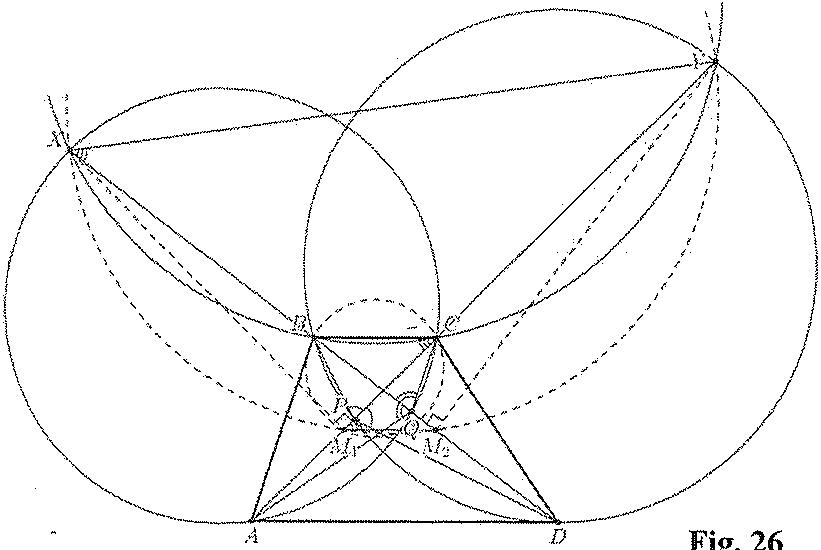
Let and be the middles of the diagonals (Fig. 26). Then . Consider circumcircles of and . Let them intersect and in points and . Since contains the bisector of , then point is the middle of the bigger arc of the circumcircle of . Then is on the perpendicular bisector of . In the same way, is on the perpendicular bisector of . So is inscribed, as . Then . Also , so is inscribed. Hence, .
Alternative solution.
Denote on point such that . Then is inscribed (Fig. 27). Hence , so is also inscribed. Then
So . Also bisects . Let us show that . Assume these points are distinct. Because of the fact that
Want a route through all this instead of an archive? The track
puts 2,604 problems in a working order, from Junior Challenge level to the IMO shortlist.