Any diagonal connecting two opposite vertices of a convex hexagon divides this hexagon into two quadrilaterals. Six quadrilaterals can be obtained in this way.
Find the greatest number of these quadrilaterals that can occur circumscribed quadrilaterals.
(S. Mazanik, I. Voronovich)
Belarusian Mathematical Olympiad
Solution
Answer: 3.
We show that at most three circumscribed quadrilaterals can be obtained. Suppose, contrary to our claim, that there are at least four circumscribed quadrilaterals. Then some two of them are obtained when one diagonal (say, ) is constructed.
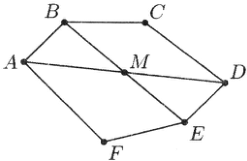
Fig. 1
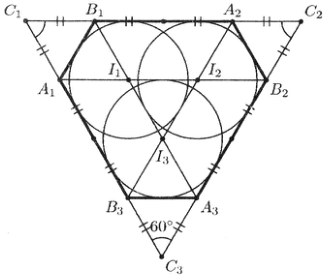
Fig. 2
Consider one of the circumscribed quadrilaterals remained. Without loss of generality we assume that this is the quadrilateral . For this quadrilateral we have . For the quadrilateral we have since, by our assumption, this quadrilateral is circumscribed. Summing these two equalities we obtain . The last equality is impossible because for the convex quadrilateral . Indeed, if is the intersection point of and , then, by the triangle inequality,
Thus the number of the circumscribed quadrilaterals is less than or equal to 3.
There are many ways to construct the convex hexagon with three circumscribed quadrilaterals. One of such hexagons is shown in Fig. 2, where , , are the circumscribed quadrilaterals.
Want a route through all this instead of an archive? The track
puts 2,604 problems in a working order, from Junior Challenge level to the IMO shortlist.