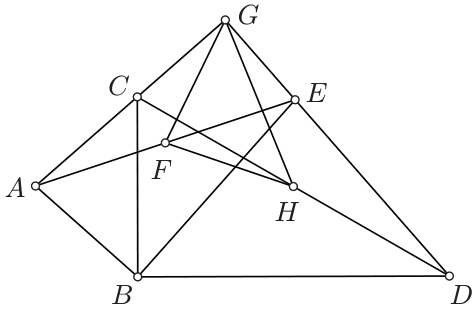
Consider the triangle ABC, with m(A)>60∘ and m(C)>30∘. In the half-plane determined by the line BC not containing A, consider points D and E so that m(ABE)=m(CBD)=90∘ and m(BAE)=m(BCD)=60∘. Denote F and H the midpoints of the segments [AE], respectively [CD], and G the common point of the lines AC and DE. Show that:
a) ΔEBD∼ΔABC;
b) ΔFGH≡ΔABC.
Solution
a) The hypothesis yields ΔABE∼ΔCBD, whence BDBE=CBAB, that is ABEB=BCBD. Since angles ABC and EBD have the same complement, ABC=EBD, hence ΔEBD∼ΔABC (S.A.S.).
b) From ΔEBD∼ΔABC follows that ACB=BDE, whence m(DGC)=360∘−(m(CBD)+m(BDE)+m(BCG))=360∘−(m(CBD)+m(ACB)+m(BCG))=90∘.
[GF] is a median in the right triangle GAE, hence GF=AE/2. Since [AB] opposes to an angle of 30∘ in the right triangle BAE, it follows that AB=21AE, hence [AB]=[FG]. In the same way, [BC]=[GH].
From △FGH≅△FBH (S.S.S.) follows that m(FGH)=m(FBH)=90∘−m(HBD)−m(CBF).
From m(HBD)=m(HDB)=30∘ and m(CBF)=m(ABF)−m(ABC)=60∘−m(ABC), we get m(FGH)=m(ABC), so △FGH≅△ABC (S.A.S.).
Want a route through all this instead of an archive? The track
puts 2,604 problems in a working order, from Junior Challenge level to the IMO shortlist.
Source: MathNet,
licensed CC-BY-4.0.
Statement reproduced verbatim; metadata (topic, difficulty) added by this project.