Given an acute triangle , let be the midpoint of and the orthocentre. Let be the circle with diameter , and let , be distinct points on such that , are tangent to . Prove that is cyclic.
BMO Shortlist, 2019
Solution
Let be the foot of the altitude from to , which also lies on . Let be the circumcentre of . Since , note that rays and meet the circumcircle at points which are reflections in . Then, since , we recover the well-known fact that ray meets the circumcircle at , the point antipodal to . Therefore, the ray meets the circumcircle at a point such that . Note that , lie on the circle with diameter .
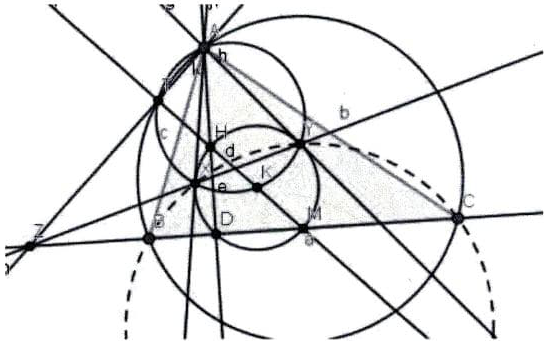
Figure 4: G4
Now, study , the centre of . Clearly is cyclic, with diameter , so also lies on this circle. We can now apply the radical axis theorem to the three circles , , to deduce that , , concur at a point, .
Then, by power of a point in , we have ; but also by power of a point in the circumcircle, we have . Therefore
and the result follows.
Want a route through all this instead of an archive? The track
puts 2,604 problems in a working order, from Junior Challenge level to the IMO shortlist.