1) Consider the inversion with center J and ratio equal to the power of J to the three circles (O1), (O2), (O3) as a function f.
It is easy to see that
f((O1))=(O1),f((O2))=(O2),f((O3))=(O3).
On the other hand, f(X)=A1, f(Y)=B1, f(Z)=C1, thus
f((XYZ))=(A1B1C1)=(O).
Because (O) is tangent to all three circles (O1), (O2), (O3), then (XYZ) is also tangent to (O1), (O2), (O3), based on the property of inversion.
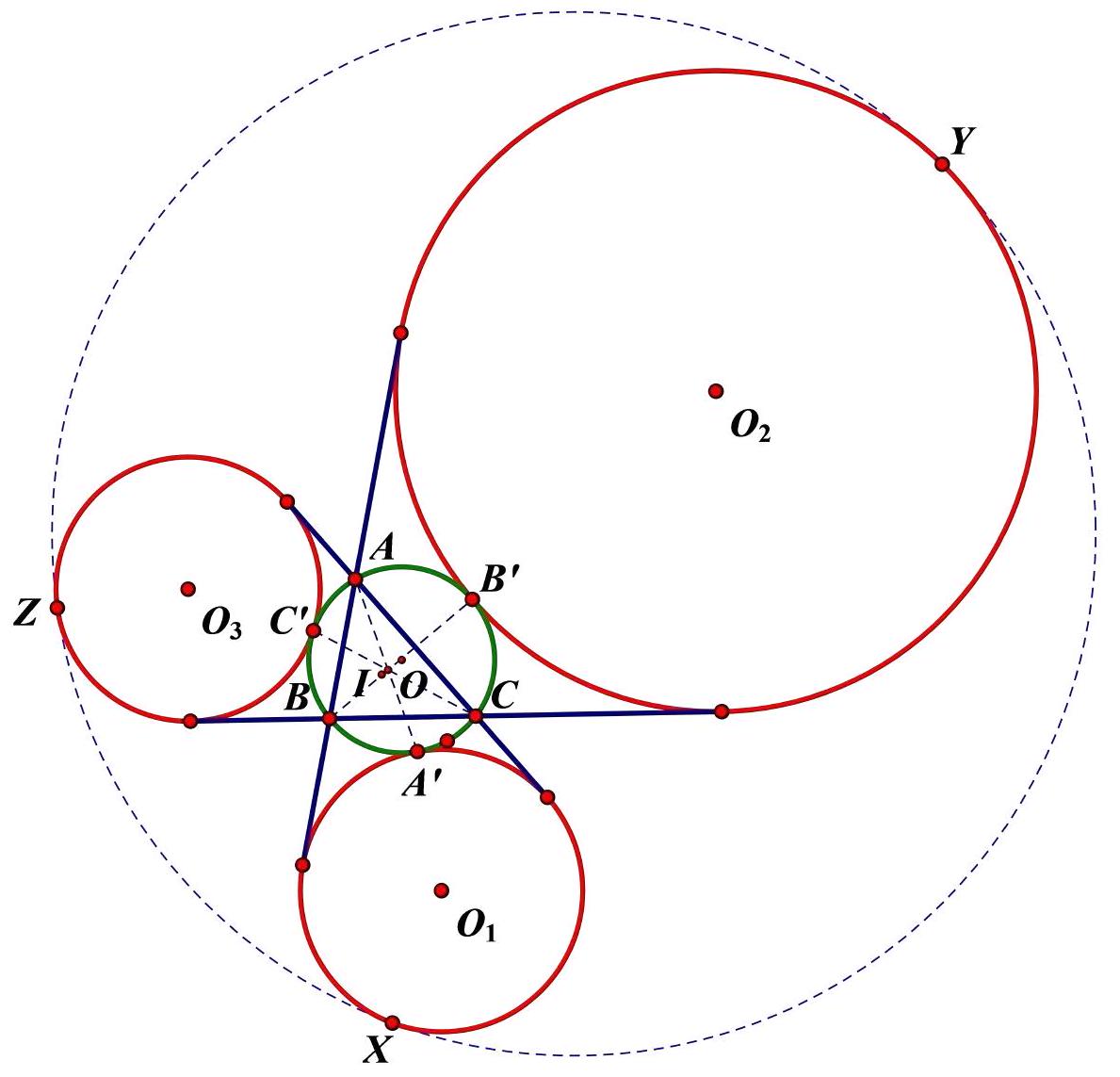
2) We will prove that AA′, BB′, CC′ are concurrent at the homothety center of (O) and (I). Indeed,
Suppose that AA′ intersects IO at M. It is easy to see that A, I, O1 are collinear and O, O1, A′ are also collinear. Denote rA as the radius of (O1).
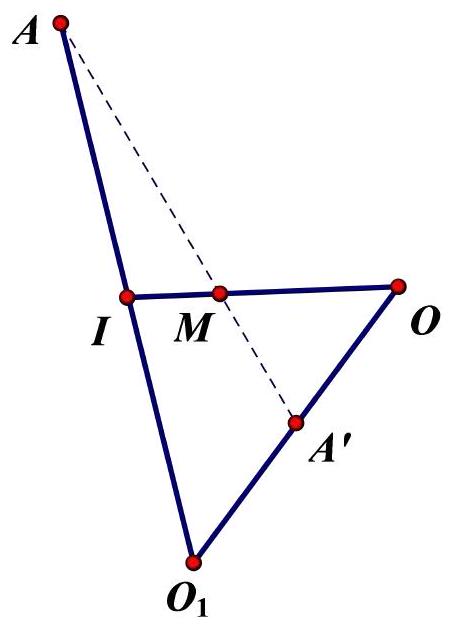
From the ratio of radii, we can see that:
AO1AI=rAr and A′O1A′O=−rAR.
By applying Menelaus' theorem, we have
AO1AI⋅A′OA′O1⋅MIMO=1⇔MIMO=AIAO1⋅A′O1A′O=rrA(−rAR)=−rR.
Hence the line AA′ passes through the point M that internally divides the segment OI with ratio rR. Similarly for BB′, CC′. Therefore, AA′, BB′, CC′ are concurrent at a point M belonging to the segment IO. □