Point is the midpoint of the side of the acute-angled triangle , points and are the feet of the altitudes and . A circle passing through , touches the side . Prove that a circle passing through touches the extension of the side .
(I. Voronovich)
Point is the midpoint of the side of the acute-angled triangle , points and are the feet of the altitudes and . A circle passing through , touches the side . Prove that a circle passing through touches the extension of the side .
(I. Voronovich)
First solution. Let be a circle passing through . Let touch the side at , and be the intersection of the lines and . Since point lies on the side , it follows that lies on the extension of the side (over ).
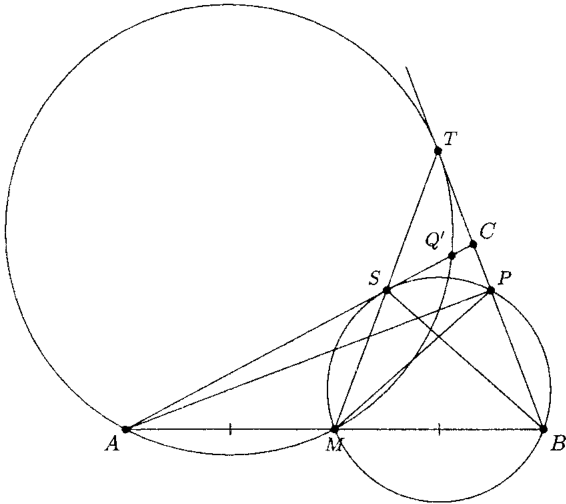
Since and is an inscribed quadrilateral, we see that , . Let . From the triangle we have . Since is an external angle of , we have . Hence . Thus, , so . By Menelaus' theorem ( and points ),
By the power of point theorem, . It is equivalent to the fact that is tangent to , passing through . Let be the intersection point of and the line . Since touches the line , we see that lies on the side (not on the extension). Further
So (chords subtending the equal arcs). Therefore, , which gives that is a right-angled triangle (). Thus , i.e. points and coincide, which completes the proof.
Second solution. Let be a circle passing through . Let touch the side at . Since and are right-angled triangles, we have , so lie on the circle with the center at . Consider the inversion (with as center) with respect to . Since passes through the center of the inversion, its image is a line , but and are fixed points, the line coincide with the line . Similarly, the image of the line () is a circle passing through , since and are fixed points.
Therefore, as the tangency point of and the side is transformed to which is the tangency point of the line and . To complete the proof, it suffices to note that lies on the ray , i.e. is the intersection point of the ray and the line . Since lies on the side , we see that lies on the extension of the side (over ).