We consider a square consisting of unit squares. We call tiles of type A the rectangular tiles or consisting of 8 unit squares. We call tiles of type B the rectangular tiles or consisting of 8 unit squares. Examine if it is possible to cover the square by using tiles of type A and tiles of type B, for some positive integer ? (The tiles must be inside the initial square and not overlapping.)
Greece — Selection Examination
Solutions — 2
Solution 1
Suppose such a coverage is possible with tiles of type A and with tiles of type B. Calculating the area of the tiles, which is and of the square which is equal to , we observe that we need of tiles of type A and 625 of tiles of type B, so .
We color the squares of the first row alternately with colors 1 and 2. That is, we have the coloring 1-2-1-2...
We color the squares of the second row alternately with colors 3 and 4. That is, we have the coloring 3-4-3-4...
We color the squares of the third row alternately with colors 1 and 2. That is, we have the coloring 1-2-1-2... and so on.
In this coloring the or contain two squares of each color. or contain two suits in 4 squares each. In the coverage they must be covered by an equal number of the colors 1,2,3,4 and type B cover an equal number of the colors, therefore the same must be the case for the type A. Therefore the type A must be an even number, out of place since it is 625.
Solution 2
Suppose such a coverage is possible with tiles of type A and with tiles of type B. Calculating the area of the tiles, which is and of the square which is equal to , we observe that we need of tiles of type A and 625 of tiles of type B, so .
We split the or type A tiles into or tiles, respectively, and the or type B tiles into or tiles, respectively, so that their center of gravity to coincide with a vertex of a square (as in the Figure)
We do the same with the square, which turns into a square.
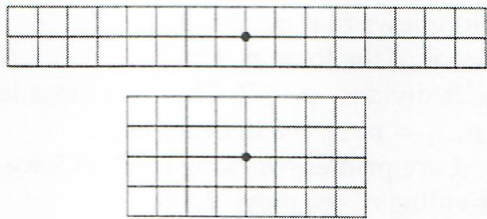
Figure 10
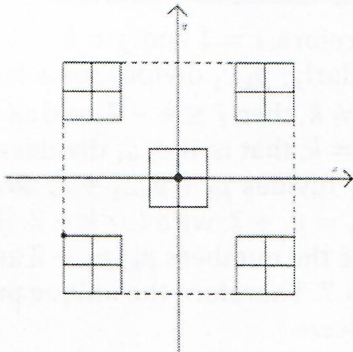
Figure 11
We do the same with the square, which turns into a square.
We consider an orthonormal coordinate system with the center of gravity of the square as the origin and the length unit of the system being the length of the small squares into which the type A and type B tiles are divided.
We notice that in any coverage of the square, the coordinates of the centroid of each type B tile are even numbers. The coordinates of the center of gravity of an A-type tile either placed parallel to the -axis or parallel to the -axis have opposite parity, i.e. one is odd and the other is even. In the first case, the ordinate is an odd number and in the second coordinate.
Since the algebraic sum of the coordinates of all the centers of gravity of the covering tiles must be 0, for the covering to be possible, we should use an even number of type A tiles of each kind. Since is an odd number, such tiling is impossible.
Want a route through all this instead of an archive? The track
puts 2,604 problems in a working order, from Junior Challenge level to the IMO shortlist.