Given the triangle , let be the excircle at the side . Choose any line parallel to intersecting line segments and at points and . Denote by the incircle of the triangle . The tangents from and to the circle not passing through intersect at . The tangents from and to the circle not passing through intersect at . Prove that the line passes through a fixed point independent of the choice of .
Cesko-Slovacko-Poljsko
Solution
Let touch in and touch in . We shall prove the required fixed point is .
First we show the points , and are collinear. Denote by and the points where and touch , and and the points where and intersect . Let and be the tangent points of and the rays and respectively.
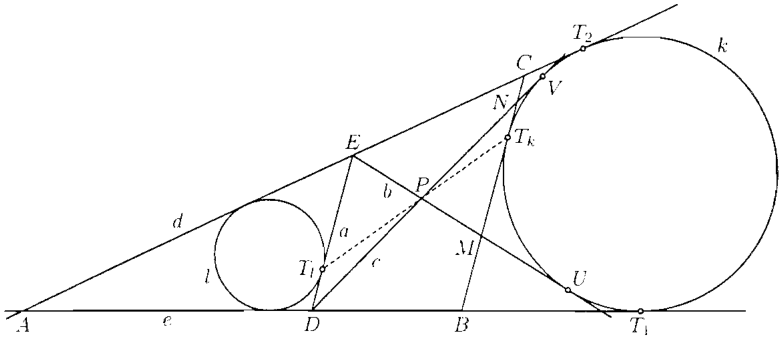
Fig. 1
As , the triangle is similar to and the homothety with the centre and the quotient maps the segment into . To prove the collinearity of , it suffices to derive the equality
if this is true, maps into .
Let be the lengths of the sides in the triangle as in fig. 1. Set , . Let us remind the well-known formulae for the length of the segments between the vertex of a triangle and the tangent points of its incircle and excircle: In any triangle , the distance of from the tangent point of the incircle and excircle (lying on ) is and respectively.
The circle is the excircle of . Hence
The circle is the incircle of . Hence
When we draw two tangent lines from a point to a circle, the distances of the two tangent points from the original point are equal. Repeating this argument several times we get
so . Then and substituting into (2) and (3) gives
which is exactly (1). Hence lies on .
Similarly we show that also , and are collinear. Denote by and the points where and touch , and and the points where and intersect . Let and be the tangent points of and the rays and respectively. Let be the lengths of the sides in the triangle and , .
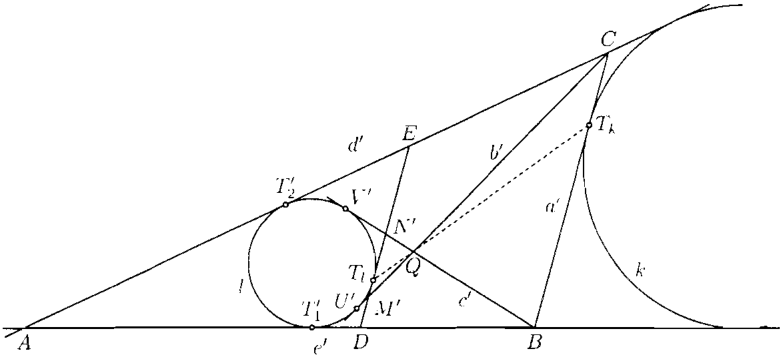
Fig. 2
Repeating the arguments from the first part (here both circles are excircles) we get
Comparing the lengths (fig. 2) gives
so and
Finally, using the homothety of and we conclude that lies on .
Therefore the line (obviously, ) is identical to the line and passes through , which is independent of the choice of .
Want a route through all this instead of an archive? The track
puts 2,604 problems in a working order, from Junior Challenge level to the IMO shortlist.