Let be a convex quadrilateral with . Prove that there exist points on the sides , respectively, such that and the area of quadrilateral is exactly half that of .
Selected Problems from Thailand Training Camp
Solution
Solution:
Denote the area of by . Let be the intersection of and . From any point on , we construct points as follows:
Let the line intersect at . Let be the line perpendicular to at . Let intersect at respectively.
Define a continuous function from a point on to the interval by where are constructed as above.
We see that . If we can find a point on such that , then by continuity there exists a point on such that . Then the construction above will yield the points as required.
Next, we prove that if bisects . We see that, in such case, bisect respectively.
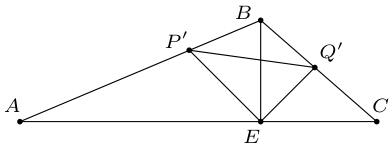
Let be the lengths of respectively. We have that the lengths of are , respectively. It follows from the AM-GM inequality that
or
Similarly,
So, as required.
Want a route through all this instead of an archive? The track
puts 2,604 problems in a working order, from Junior Challenge level to the IMO shortlist.