Label the sixteen points A, B, C, …, P, as shown below in Figure 1:
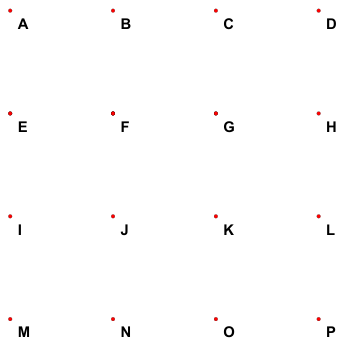
A selection of four points satisfying the condition that the distance between every two of the four points is greater than 2, will be called a valid selection.
Let us first consider a valid selection which includes one of the points of the inner square FGKJ. Clearly, only one of these points (F, G, K, J) can be used; say we select F. The only points from the outer square ABCDHLPONMIE at distance more than 2 from F, are D, L, P, O and M. If we choose either L or O, then there are not enough points left among the remaining ones on the outer square to form a valid selection. We are therefore forced to select D, P and M, together with F, to obtain a valid selection. Similarly, by symmetry, there are three further valid selections that contain points from the inner square: {G,P,M,A}, {K,M,A,D} and {J,A,D,P}.
All that remains, is to consider valid selections using only points from the outer square. We note that the only way to choose two points in a valid selection from the same side of the outer square, is to choose two corner points, such as A and D. But then the only option for the other two points in the valid selection would be to choose the other two corner points of the outer square, P and M, giving the valid selection {A,D,P,M}. Moving away from corner points, leaves us with the two remaining valid selections (where only one point from each of the sides of the outer square is selected), namely {B,H,O,I} and {C,L,N,E}.
Hence, there are seven possible valid selections.