We will work with oriented angles between lines. For two straight lines ℓ,m in the plane, ∠(ℓ,m) denotes the angle of counterclockwise rotation which transforms line ℓ into a line parallel to m (the choice of the rotation centre is irrelevant). This is a signed quantity; values differing by a multiple of π are identified, so that
∠(ℓ,m)=−∠(m,ℓ),∠(ℓ,m)+∠(m,n)=∠(ℓ,n).
If ℓ is the line through points K,L and m is the line through M,N, one writes ∠(KL,MN) for ∠(ℓ,m); the characters K,L are freely interchangeable; and so are M,N.
The counterpart of the classical theorem about cyclic quadrilaterals is the following: If K,L,M,N are four noncollinear points in the plane then
K,L,M,N are concyclic if and only if ∠(KM,LM)=∠(KN,LN).(1)
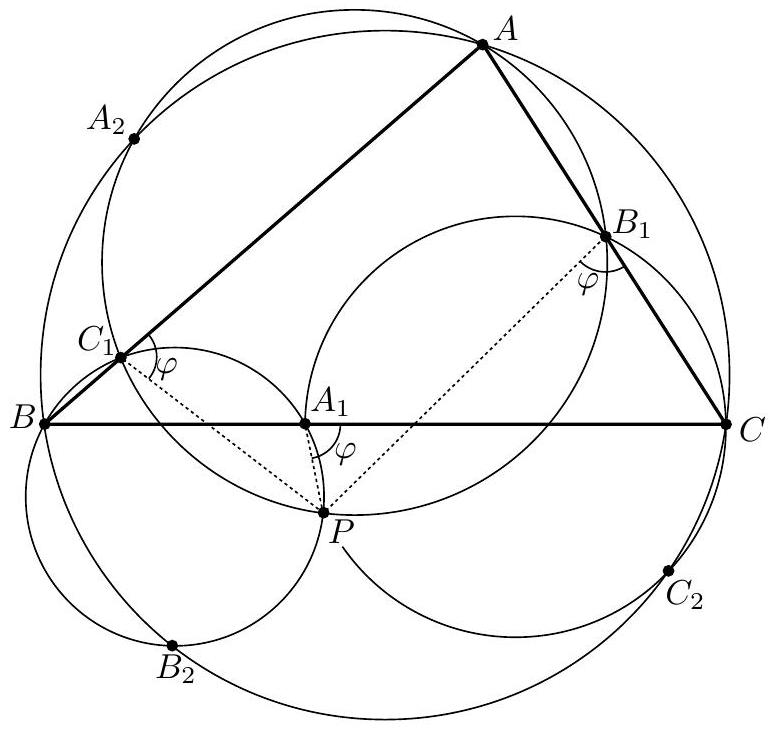
Passing to the solution proper, we first show that the three circles (AB1C1), (BC1A1), (CA1B1) have a common point. So, let (AB1C1) and (BC1A1) intersect at the points C1 and P. Then by (1)
=∠(PA1,CA1)=∠(PA1,BA1)=∠(PC1,BC1)∠(PC1,AC1)=∠(PB1,AB1)=∠(PB1,CB1)
Denote this angle by φ.
The equality between the outer terms shows, again by (1), that the points A1,B1,P,C are concyclic. Thus P is the common point of the three mentioned circles.
From now on the basic property (1) will be used without explicit reference. We have
φ=∠(PA1,BC)=∠(PB1,CA)=∠(PC1,AB).(2)
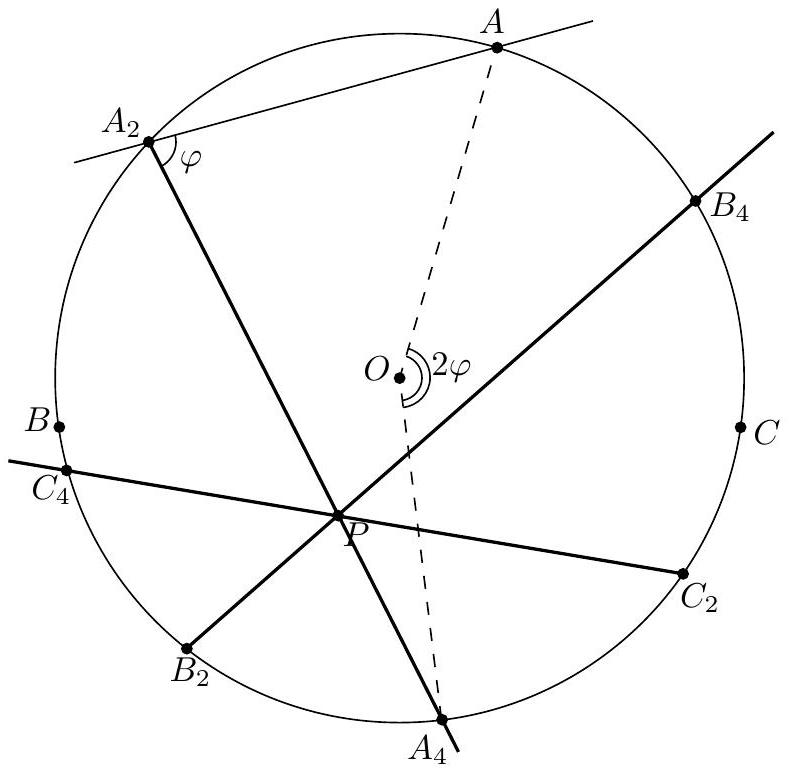
Let lines A2P, B2P, C2P meet the circle (ABC) again at A4, B4, C4, respectively. As
∠(A4A2,AA2)=∠(PA2,AA2)=∠(PC1,AC1)=∠(PC1,AB)=φ,
we see that line A2A is the image of line A2A4 under rotation about A2 by the angle φ. Hence the point A is the image of A4 under rotation by 2φ about O, the centre of (ABC). The same rotation sends B4 to B and C4 to C. Triangle ABC is the image of A4B4C4 in this map. Thus
∠(A4B4,AB)=∠(B4C4,BC)=∠(C4A4,CA)=2φ.(3)
Since the rotation by 2φ about O takes B4 to B, we have ∠(AB4,AB)=φ. Hence by (2)
∠(AB4,PC1)=∠(AB4,AB)+∠(AB,PC1)=φ+(−φ)=0,
which means that AB4∥PC1.
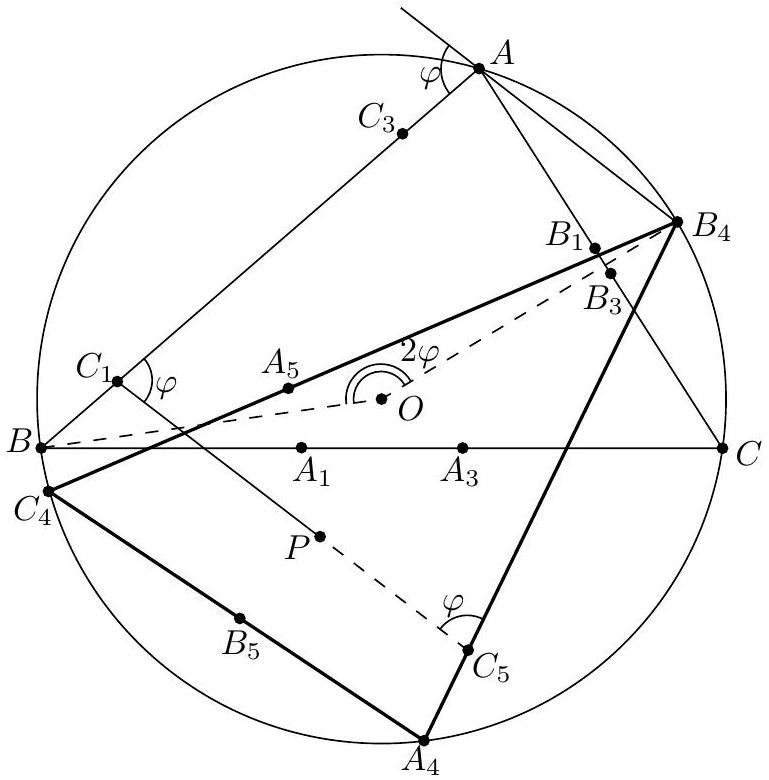
Let C5 be the intersection of lines PC1 and A4B4; define A5,B5 analogously. So AB4∥C1C5 and, by (3) and (2),
∠(A4B4,PC1)=∠(A4B4,AB)+∠(AB,PC1)=2φ+(−φ)=φ;(4)
i.e., ∠(B4C5,C5C1)=φ. This combined with ∠(C5C1,C1A)=∠(PC1,AB)=φ (see (2)) proves that the quadrilateral AB4C5C1 is an isosceles trapezoid with AC1=B4C5.
Interchanging the roles of A and B we infer that also BC1=A4C5. And since AC1+BC1=AB=A4B4, it follows that the point C5 lies on the line segment A4B4 and partitions it into segments A4C5, B4C5 of lengths BC1(=AC3) and AC1(=BC3). In other words, the rotation which maps triangle A4B4C4 onto ABC carries C5 onto C3. Likewise, it sends A5 to A3 and B5 to B3. So the triangles A3B3C3 and A5B5C5 are congruent. It now suffices to show that the latter is similar to A2B2C2.
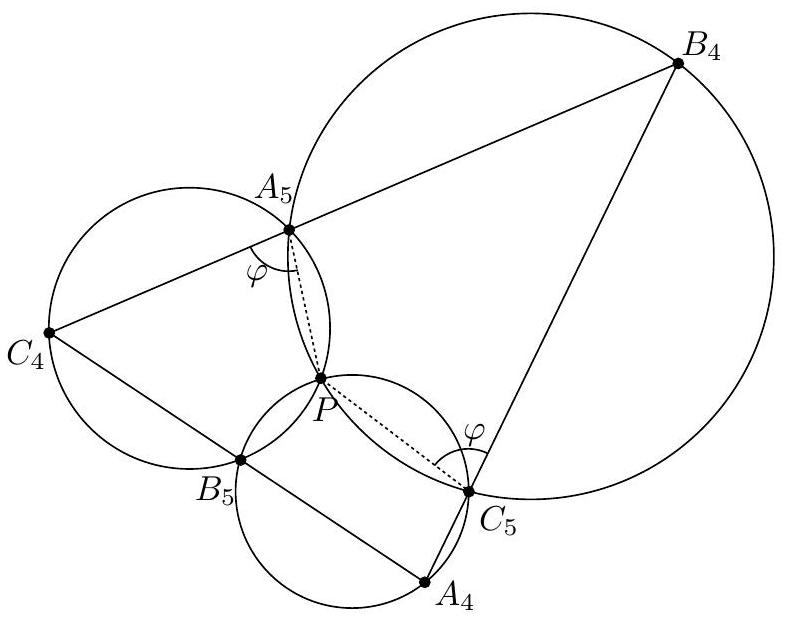
Lines B4C5 and PC5 coincide respectively with A4B4 and PC1. Thus by (4)
∠(B4C5,PC5)=φ.
Analogously (by cyclic shift) φ=∠(C4A5,PA5), which rewrites as
φ=∠(B4A5,PA5).
These relations imply that the points P,B4,C5,A5 are concyclic. Analogously, P,C4,A5,B5 and P,A4,B5,C5 are concyclic quadruples. Therefore
∠(A5B5,C5B5)=∠(A5B5,PB5)+∠(PB5,C5B5)=∠(A5C4,PC4)+∠(PA4,C5A4).(5)
On the other hand, since the points A2,B2,C2,A4,B4,C4 all lie on the circle (ABC), we have
∠(A2B2,C2B2)=∠(A2B2,B4B2)+∠(B4B2,C2B2)=∠(A2A4,B4A4)+∠(B4C4,C2C4).(6)
But the lines A2A4,B4A4,B4C4,C2C4 coincide respectively with PA4,C5A4,A5C4,PC4. So the sums on the right-hand sides of (5) and (6) are equal, leading to equality between their left-hand sides: ∠(A5B5,C5B5)=∠(A2B2,C2B2). Hence (by cyclic shift, once more) also ∠(B5C5,A5C5)=∠(B2C2,A2C2) and ∠(C5A5,B5A5)=∠(C2A2,B2A2). This means that the triangles A5B5C5 and A2B2C2 have their corresponding angles equal, and consequently they are similar.